
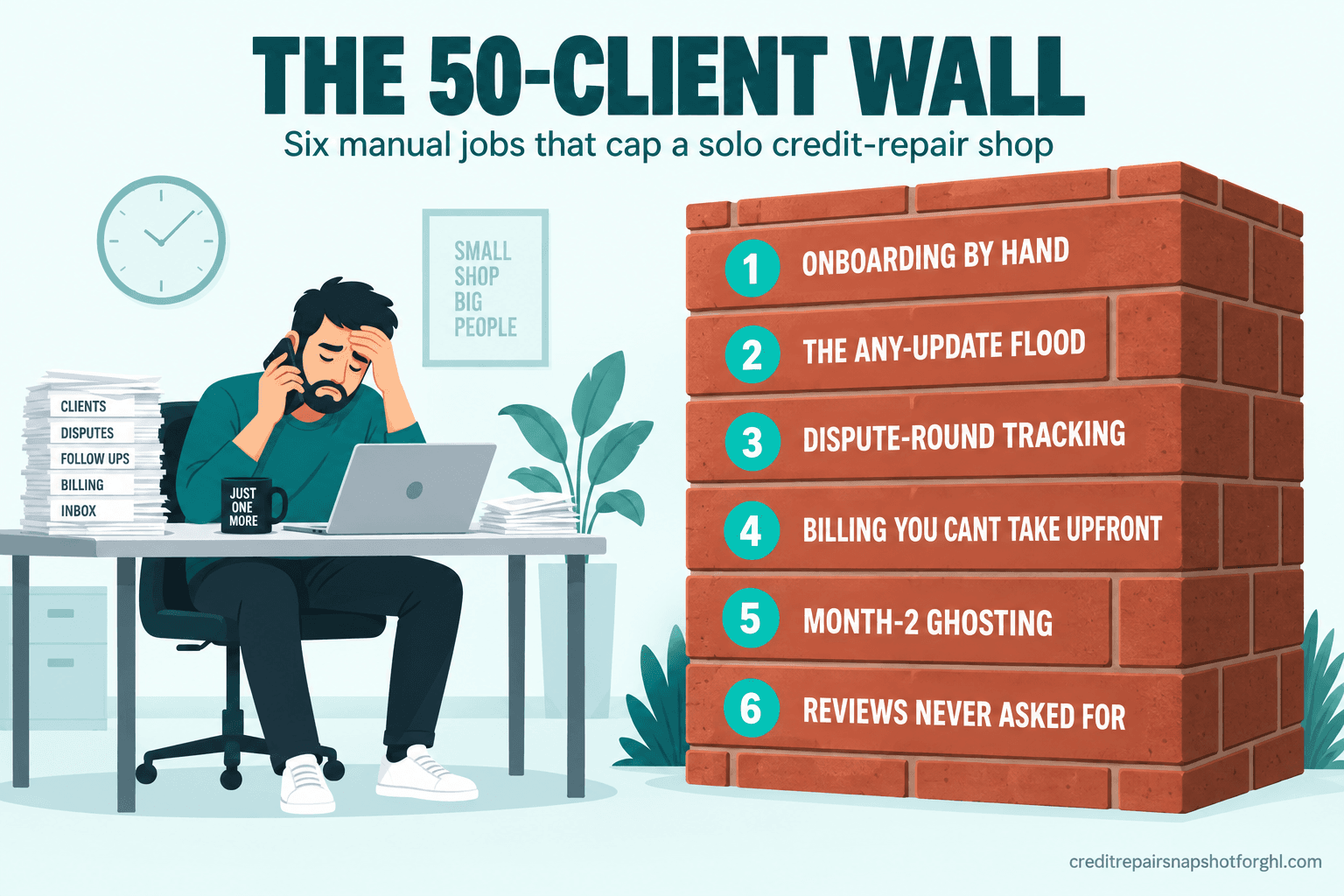
It is 8:15 on a Tuesday. You have three new clients to onboard, a stack of round-two disputes from Friday, two “any update?” texts unanswered, a card that failed overnight, and a month-one client who has gone quiet. You are one person, and every one of those jobs needs you.
That is the 50-client wall, and almost every solo or two-person credit-repair shop hits it. It does not feel like a marketing problem. The leads are there. You just cannot take on client 51 without something already on your plate hitting the floor.
The answer up front: you can’t scale past 50 clients because six manual jobs each take a fixed slice of your day, and at around 50 active files those slices add up to more hours than you have. Hiring is slow; working more nights is not a plan. The way through is to move the repeatable work, the part that runs around your disputes, onto a system that does it the same way every time. This post walks the six bottlenecks and hands you the message copy to fix each one.
One note: this is about operations, never outcomes. Nothing here disputes an item or promises a score change. The disputes stay your work, in your software.
Table of contents
- The 50-client wall is a time problem
- What the ceiling actually costs you
- The six bottlenecks, at a glance
- Onboarding every client by hand
- Becoming the human status API
- Tracking dispute rounds in your head
- Billing you cannot take upfront
- Month-two ghosting
- Reviews that never get asked for
- The same six jobs at three sizes
- The compliance layer you cannot skip
- Objections
- FAQ
The 50-client wall is a time problem, not a demand problem
The number is not magic. For some it is 40, for some 70. The wall lands wherever your six recurring jobs fill your available hours. The shape is the same for everyone: you did not run out of leads, you ran out of you. When growth stalls the instinct is to spend more on marketing, but then the new leads arrive, you cannot serve them well, a few month-one clients cancel, and you land back at your old headcount with a bigger ad bill.
Nearly a third of U.S. consumers carry a subprime score. Source: Experian, 2025.
Nearly a third of the country carries a subprime score, and the average FICO score slipped to 713 in 2025 (Experian). Credit and consumer reporting was the most-complained-about category the CFPB tracked in 2025, at more than 5.8 million filings, about 88% of the 6.6 million complaints it received across every product (CFPB, 2025). Demand is not your problem. Your calendar is.
What the ceiling actually costs you
Stalling at 50 is not neutral. It costs you three ways that compound.
It caps revenue at your worst week. If a full plate is 50 clients when things run smoothly, then the week a card fails, two clients get anxious, and disputes come due at once, you are underwater. So you hold below 50 for slack, and your ceiling becomes your hardest week, not your average one.
It taxes the clients you have. When you are maxed out, the newest fire gets attention and everyone else waits. The month-three client who needed a two-line update gets silence, and drifts toward cancelling. You lose clients out the back as fast as you win them at the front.
It raises the stakes on compliance. When you rush, the paperwork slips first, and here the paperwork is the law. The FTC returned more than $3.5 million to consumers in one 2025 case and banned the operators for life (FTC, 2025). A 2026 action stopped a scheme that took nearly $200 million on illegal advance fees (FTC, 2026). Nobody plans to break CROA. They break it because they were busy.
The six bottlenecks, at a glance
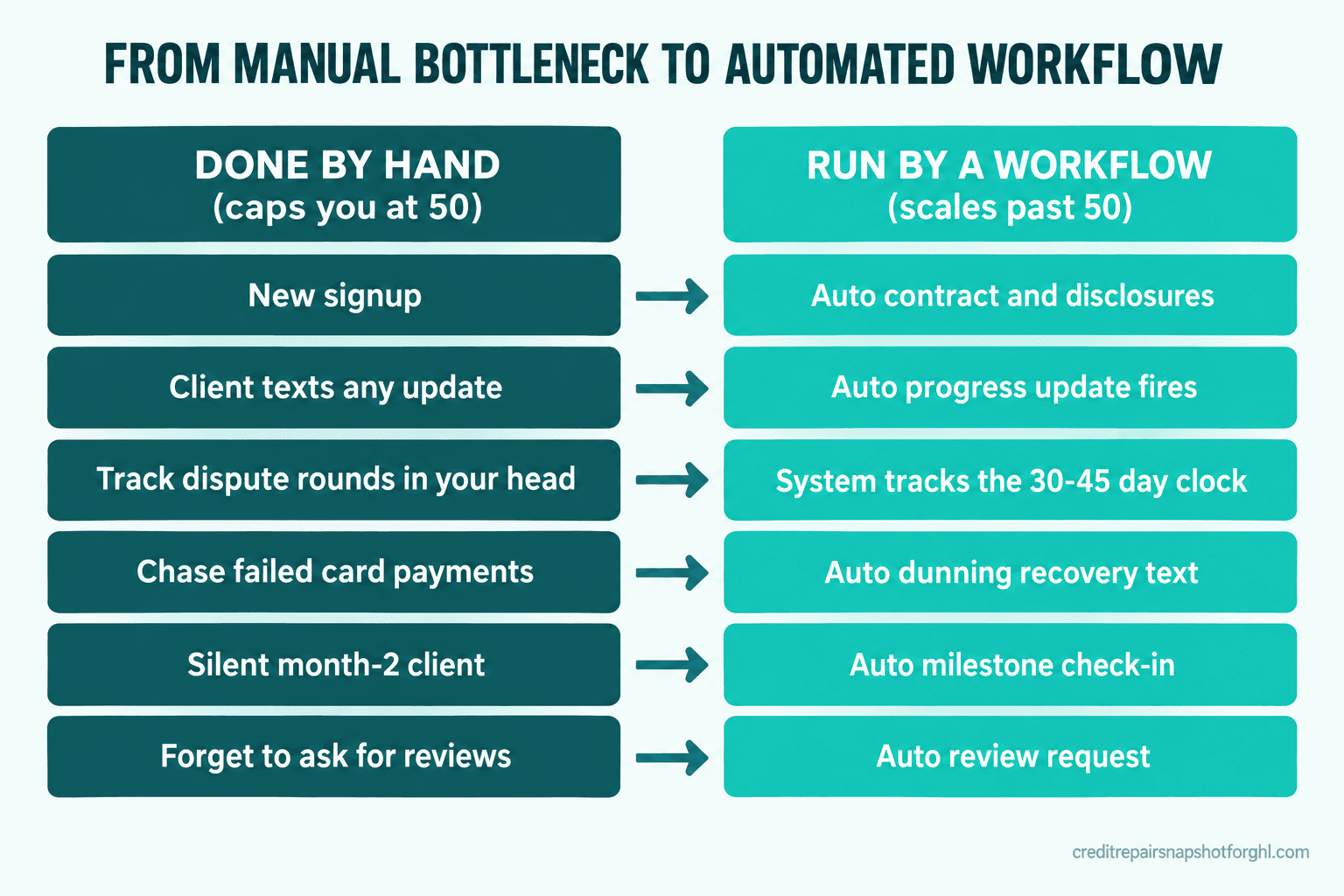
Every job on your plate falls into one of six buckets, each repeatable and each fixable with a workflow that does it the same way every time. None require your judgment every time, which is exactly what makes them automatable.
Bottleneck 1: Onboarding every client by hand
What it is. A new client says yes, and you personally send the agreement, collect documents, set up the file, and send a welcome note. Once, it is twenty minutes. For every signup while serving fifty files, it is the thing that makes you dread a good sales week.
How it breaks. Under pressure, onboarding is where corners get cut, and this is the worst place to cut them. CROA requires a written, signed, dated contract before any service, with a full description of services and the total charge (15 U.S.C. §1679d), plus a separate statement of rights and a three-business-day cancellation right (15 U.S.C. §1679e). Miss a document in the rush and you have a compliance gap on file.
The fix. Build onboarding once as a workflow and let it run. A signup triggers the contract and disclosures, logs the cancellation clock, and creates the file without you touching it. Our CROA-compliant onboarding checklist walks the sequence, so the same complete packet goes out every time.
Bottleneck 2: Becoming the human status API
What it is. Your clients are anxious. Their credit is personal and slow-moving, so they check in. When you are the only source of a status, every check-in routes to your phone. Fifty clients checking in once a week is fifty interruptions.
How it breaks. You cannot answer them all fast, so replies lag. A lagging reply reads as “nothing is happening,” the exact feeling that makes a client cancel.
The fix. Get ahead of the question. When a file changes, a dispute goes out, or a round closes, an update fires without you writing it. A progress-tracking client portal lets clients self-serve the answer at 11pm. You are removing the human bottleneck from the routine 80% so you have time for the 20% that needs you personally.
Bottleneck 3: Tracking dispute rounds in your head
What it is. Credit repair runs in rounds, and rounds run on the clock. A bureau has 30 days, extendable to 45, to reinvestigate a dispute (15 U.S.C. §1681i). For every client you hold a mental timer for when the next round is due. Multiply by fifty clients and no brain can hold it.
How it breaks. You forget one. A client sits an extra three weeks between rounds because a timer slipped, notices the gap, and now you are explaining an avoidable delay. The spreadsheet you built to fix this becomes its own job that goes stale the day you get busy.
The fix. Let the system hold the timers. When a round is logged, the reinvestigation window is tracked and you get a reminder the day the next action is due. The mechanics, without weakening compliance, are in our guide to automating dispute rounds. The dispute work stays yours. The remembering does not.
Bottleneck 4: Billing you cannot take upfront
What it is. Cash flow is the quiet killer, and the reason is the law. CROA prohibits charging or receiving any money for a service before it is fully performed (15 U.S.C. §1679b(b)). You carry the effort first, then bill monthly, so you are always fronting months of labor before the money catches up.
How it breaks. Cards fail. Someone forgets an expired card, a payment bounces, and now you are chasing money by hand. Skip the chase and revenue leaks silently; do it by hand and it eats the hours you needed for client work.
The fix. Automate the billing and, more importantly, the recovery. Monthly charges run on schedule, and when one fails, a polite dunning sequence texts and emails the client to update their card before you ever make it personal. We break the full sequence down in recurring billing without chargebacks. This one bottleneck is often the difference between a shop that can afford to grow and one that cannot.
Keep it warm and no-blame. The goal is a card update, not a confrontation.
Bottleneck 5: Month-two ghosting
What it is. The most dangerous stretch is the slow middle. Month one is exciting because they just signed up. But real progress takes time, negative information can legally stay on a report for up to seven years, and there is no quick fix (FTC). So around month two, when the rush is over and results are still cooking, clients go quiet. Quiet is the sound of a client about to cancel.
How it breaks. When you are maxed out, silent clients are the ones you deprioritize, because they are not on fire. That is backwards. The silent client is the fire, you just cannot see the smoke yet.
The fix. Fill the quiet middle with automated proof-of-life: milestone nudges, small wins, and check-ins that keep the engine feeling alive during a legally required wait. The seven flows are in our retention automations for credit repair, and when someone slips away, the win-back sequence gives you a compliant path back. None of it promises a result. All of it communicates effort, which is what keeps someone enrolled.
Bottleneck 6: Reviews and referrals that never get asked for
What it is. Your happiest clients are your cheapest marketing. A steady flow of five-star reviews and warm referrals lowers your lead cost, which matters enormously when you cannot charge upfront and every acquisition dollar is fronted. But asking for a review is a task, and tasks with no deadline never happen when you are underwater.
How it breaks. You stay dependent on paid leads because you never harvested the free ones, and a rare unhappy client posts publicly because nobody gave them a private place to vent first.
The fix. Automate the ask, and time it to a moment of genuine satisfaction. A positive signal triggers a review request, and a routing step sends thrilled clients to your public profile and unhappy ones to a private form you can respond to. That closes the loop: better retention feeds more reviews, and more reviews lower the lead cost that makes growth affordable.
The same six jobs at three sizes
The six bottlenecks do not disappear as you grow. They change shape.
Solo, 0 to 50 clients. All six jobs are on your hands and you are the constraint. Your best first move is not hiring, it is systematizing, because a person hired to do manual work moves the bottleneck rather than removing it. Automate onboarding, updates, and billing recovery first. If you are still choosing tools, start with our comparison of the best credit repair software for solo operators.
Small team, 50 to 150 clients. With one or two staff, the danger changes. Processes that lived in your head do not transfer cleanly, so quality gets inconsistent and compliance gets riskier. Here the system becomes the source of truth: workflows enforce the compliant sequence so every client gets the same treatment no matter who handles them.
Agency, 150+ clients or reselling. Now the questions become carrier registration for messaging volume, per-seat tooling, and whether to stay on one platform or move to custom software. Our breakdown of the real cost of building versus buying a GoHighLevel setup is written for this decision. The six jobs are the same, only now fully industrialized.
The compliance layer you cannot skip
Every fix above has to run inside the rules, because in credit repair the operational layer and the legal layer are the same layer. Three things matter most.
Advance fees stay banned, at any scale. Automating billing does not change CROA. You still cannot charge for a service before it is fully performed (15 U.S.C. §1679b(b)). Your billing must run in arrears, never as a big upfront charge, and a system enforces that timing the same way every time instead of leaving it to a busy-day judgment call.
Your texting has to survive carrier registration. The moment you automate updates you are sending business SMS at volume, and credit repair is debt-relief-adjacent, which routinely gets rejected at A2P 10DLC. We wrote a full playbook on why credit-repair texts get rejected at A2P 10DLC.
State rules stack on federal ones. Depending on where you operate, you may face state registration, bonding, or an outright ban. Automation exempts you from none of it. Build your consent language, disclosures, and cancellation handling to the strictest rule you are subject to, because a workflow leaves a record and never forgets a step.
Objections
“Won’t automated texts feel impersonal?” They feel impersonal when they are generic and badly timed. The messages above fire on a real event in that client’s file, use the client’s name and actual next step, and pre-answer the question they were about to text you. Most cancellations are not about a bad result, they are about unanswered questions and silence.
“I already pay for dispute software.” Then keep it. Your dispute software runs the letters, rounds, and bureau work. That is not what caps you at 50 clients. What caps you is everything around the disputes, and most dispute tools do little of that.
“Do I need to be technical?” No. The hard part, wiring the workflows and getting the compliance sequence right, is already done in a prebuilt system. You are comfortable with a dashboard; that is the skill required.
“What if I only have 20 clients today?” Then this is the best time. Building the system at 20 means you never hit the wall in the first place.
Frequently asked questions
Why do solo credit repair operators get stuck around 50 clients?
Because six recurring jobs (onboarding, status updates, dispute-round tracking, billing, retention, and reviews) each take a fixed slice of your day, and at roughly 50 active files they add up to more hours than one person has. It is a capacity ceiling, not a demand ceiling.
Does this software dispute items or repair credit for me?
No. It runs the operations around your disputes: onboarding, progress updates, dispute-round reminders, billing, retention, and reviews. You still run the disputes yourself, in your own software. Nothing here promises a score change or a deleted item.
How does automated billing stay CROA-compliant if I can't charge upfront?
CROA bars charging for a service before it is fully performed (15 U.S.C. §1679b(b)). Compliant automation bills in arrears or monthly as work is completed, never as a large advance fee, and recovers failed payments so you are not chasing cards by hand.
Will automated texts get me flagged?
Only if you skip carrier registration. Credit repair is debt-relief-adjacent and is routinely rejected at A2P 10DLC, which makes texts silently fail to deliver. Register properly, keep clear opt-in and STOP handling, and your updates are compliant and deliverable.
Isn't hiring someone a better way to scale?
Hiring a person to do manual work moves the bottleneck rather than removing it, and a new hire who does not know your compliance rules adds risk. Systematize the repeatable jobs first, so your team manages a working process instead of reinventing it.
How fast can this be running?
The workflows are prebuilt, so the work is configuration, not construction. A done-for-you snapshot installs the whole operational layer into your GoHighLevel account in about 24 hours. Building it by hand is measured in weeks.