It is the end of your third month in business. You have eleven clients, a Credit Repair Cloud login, and a bank balance that says you are somehow losing money on a service people are paying for. That gap is almost never the software you picked. It is the three or four bills stacked behind it, plus the cash you fronted before CROA lets you collect a dime. The short answer: for a true solo operator, the cheapest capable business tier is usually Client Dispute Manager, DisputeBee, or ScoreCEO at roughly $99 to $149 a month; Credit Repair Cloud is the safest on-ramp for a total beginner but the most expensive to grow into; and DisputeFox is the closest to an all-in-one, though you have to sit through a demo to price it. The tool is the small decision. The total monthly cost, and the months of runway you need before that cost pays for itself, is the big one.
We sell the operating system, never the outcome. Nothing here promises a score change or a deletion, and neither should any software you buy. These are dispute and workflow tools. Your firm stays the credit-repair organization responsible for the contract, the disclosures, and the compliance.
Table of contents
- The honest answer for a solo operator
- Why “which is cheapest” is the wrong question
- The five tools at a glance
- Credit Repair Cloud
- DisputeFox
- ScoreCEO
- Client Dispute Manager
- DisputeBee
- What it really costs, by shop size
- The hidden costs nobody quotes you
- Steal this: your real cost worksheet
- Common objections, answered
- Frequently asked questions
- About the author
- Sources
The honest answer for a solo operator
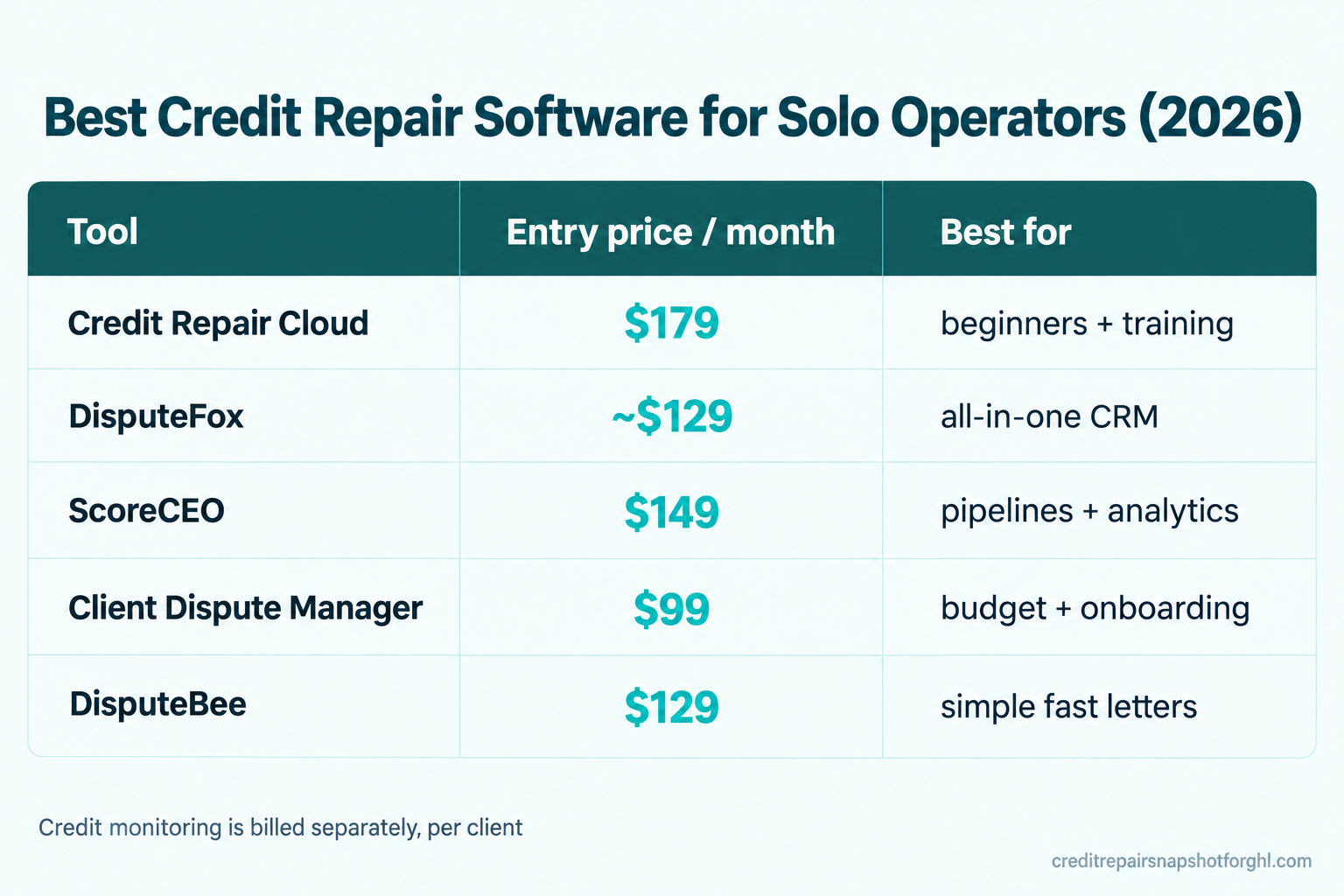
If you are one person with fewer than 30 clients, buy the cheapest tool that generates compliant dispute letters and holds your client records without making you think: Client Dispute Manager from roughly $99, DisputeBee Business at $129, or ScoreCEO from $149. All three do the core job: import a report, build a round of disputes, track responses, and store your files.
If you have never run a credit-repair shop and want hand-holding, coaching, and a big community, Credit Repair Cloud is the on-ramp most people take, and its $179 Start plan is fine for a while, though you are buying the training more than the software and the price climbs hard as you grow. If you want the letters, the CRM, and the client marketing under one roof and you do not mind a sales call, DisputeFox is the most all-in-one of the five, and you pay for that breadth in setup time.
That is the recommendation. The rest of this is why, what each one costs once the hidden bills land, and where each one breaks.
Why “which is cheapest” is the wrong question
Here is the thing nobody selling you software will lead with. The credit-repair market is not shrinking, but the number of firms is. IBISWorld counts 41,053 credit-repair businesses in the US in 2025, down 1.2% from the year before, and falling about 4.4% a year on average since 2020 (IBISWorld). Meanwhile the market itself grew to $6.8 billion in 2025, up 6.3% (IBISWorld). Read those two numbers together: fewer firms, more revenue. The money is concentrating in the operators who survive the first year. The ones who do not survive almost always die on cash flow, not on software features.
Demand is not your problem. About 30% of US consumers carry a subprime score under 670, against an average FICO of 713 in 2025 (Experian). There are always people who need the help. The problem is that you cannot bill them the way a normal business bills.
CROA, the federal law that governs your firm, is blunt about it: no credit-repair organization may charge or collect any money for a service until that service is fully performed (FTC). There is no “setup fee,” no “enrollment fee,” no advance retainer that survives the ban. So you sign a client, you do a full month of dispute work, and only then can you collect. You are effectively a lender to your own clients for the first cycle. That is why runway, not the $30 you save on a cheaper plan, is what decides whether you are still open in month six.
So judge software on total cost and how fast it lets you get real work done, not on the sticker price. A tool that is $40 cheaper but adds a week to every client’s first dispute round is the expensive one.
The five tools at a glance
These are the five tools a solo operator actually shops. Prices are the business tiers as published or reported in 2026; confirm on each vendor’s page before you buy, because tiers move.
| Tool | Entry business price | Client capacity | Best for | The catch |
|---|---|---|---|---|
| Credit Repair Cloud | $179/mo (Start) | 300 clients | Total beginners who want training + community | Price jumps to $399 then $599 as you grow (CRC) |
| DisputeFox | ~$99 to $129/mo (reported) | 100 per user, +100 for $20 | Operators wanting an all-in-one CRM + letters | Full pricing gated behind a demo (SaaSworthy) |
| ScoreCEO | $149 to $299/mo | Scales by tier | Owners who want pipelines + analytics built in | Higher tiers add up fast (ScoreCEO) |
| Client Dispute Manager | from ~$99/mo | Unlimited analysis on entry plan | Budget-conscious solos who want onboarding help | Interface feels dated to some (Capterra) |
| DisputeBee | $129/mo (Business) | Unlimited team + clients | Solos who want simple, fast letter generation | Fewer CRM and marketing features (Investographer) |
Notice how tightly the entry prices cluster, between about $99 and $179. On sticker price alone you almost cannot choose wrong. The real spread opens up in what happens next: how the price scales, what breaks, and what you still have to buy separately.
Credit Repair Cloud
Credit Repair Cloud (CRC) is the name almost every new operator hears first, because it runs the biggest training machine in the niche. That is genuinely useful when you are starting from zero.
What it costs. CRC publishes a full ladder: Personal at $49/mo (up to 3 active clients, one user), Start at $179/mo (marked “most popular,” up to 300 clients), Grow at $299/mo (up to 600 clients), then Scale at $399/mo (12 team members, 1,200 clients) and Enterprise at $599/mo (24 team members, 2,400 clients) (Credit Repair Cloud). There is a 30-day free trial with no card required, and yearly billing knocks off about 20%.
Credit Repair Cloud monthly price by plan (2026). The $49 Personal plan caps at 3 clients, so any real business is on Start or above. Source: Credit Repair Cloud pricing.
Where it shines. The onboarding, the challenge programs, and the community are the product for a beginner. If you have never sent a dispute letter, CRC walks you through it. The letter library is deep and the workflow is proven across a lot of firms.
Where it breaks for a solo operator. The $49 Personal plan looks like a deal until you notice the three-client cap, which no paying business stays under. So your real starting price is $179, not $49. From there the ladder climbs fast: outgrow 300 clients and you are at $299 for Grow, then $399 for Scale, then $599 for Enterprise. Operators also lean hard on the training content, which can feel like a funnel toward more paid programs. CRC is the safe first tool. It is rarely the cheapest one you keep.
DisputeFox
DisputeFox pitches itself as the modern all-in-one: dispute engine, CRM, email marketing, and customizable workflows in one place. For an operator tired of stitching tools together, that is appealing.
What it costs. This is the one price you have to work for. DisputeFox steers you toward a demo before it shows full tiers. Reported pricing puts the entry point around $99 to $129 a month, with higher tiers climbing toward $499, each additional user adding 100 client slots, or 100 more clients for $20/mo (SaaSworthy, SoftwareSuggest). Treat those as reported figures and confirm on the call.
Where it shines. Breadth. If you want your letters and your client communication in the same login, DisputeFox is the closest of the five to that promise. The mobile app and progress-report features get called out in reviews as genuinely useful for keeping clients in the loop.
Where it breaks for a solo operator. Two things. First, the demo wall: when you are one person pricing five tools on a Tuesday night, “book a call to see pricing” is friction that costs DisputeFox real shoppers. Second, all-in-one is only a saving if you use all of it. A solo op who just needs letters is paying for a marketing suite they will not touch for a year.
ScoreCEO
ScoreCEO markets itself to the owner who thinks like a business operator, not just a letter-sender: sales pipelines, client workflows, an analytics dashboard, and a dispute engine in one system.
What it costs. ScoreCEO publishes three tiers: KickStart at $149/mo, Essential at $199/mo (roughly 35 to 50 active clients), and Advanced at $299/mo (300+ clients), with a 7-day trial and no card (ScoreCEO). The 7-day window is short, so plan to test it hard and fast.
Where it shines. The pipeline-and-analytics framing is the differentiator. If you care about seeing conversion from lead to enrolled client and want that inside the same tool that runs disputes, ScoreCEO leans into that better than a pure letter tool like DisputeBee.
Where it breaks for a solo operator. The 7-day trial is genuinely tight for a niche where onboarding a test client and running a first round takes longer than a week. You can burn the whole trial before you have seen a real dispute cycle. And the higher tiers climb quickly, so the “from $129” number is a floor, not a ceiling. A solo op should map exactly which tier they need before the card goes in.
Client Dispute Manager
Client Dispute Manager (CDM) is the value pick that keeps showing up on budget shortlists, partly because it pairs a low entry price with real human onboarding.
What it costs. Its Starter plan is reported around $99/mo, with higher tiers commonly cited near $149 and $199 (some listings run higher), and plans that include free one-on-one onboarding sessions plus in-app training (Capterra, GetApp). An annual plan cuts the cost further.
Where it shines. The free one-on-one onboarding is a real advantage for a solo op with no team to lean on. The entry plan advertises unlimited credit analysis, so you are not metered on the core task while you are small. For a first paid tool on a tight budget, CDM is one of the strongest values on this list.
Where it breaks for a solo operator. Reviews consistently note the interface feels dated next to newer tools, and some workflows take more clicks than they should. That is a papercut, not a dealbreaker, but if you value a clean modern UI you will feel it daily. As with the others, the jump to its top tier is where “budget pick” stops being true, so know what triggers that jump before you grow into it.
DisputeBee
DisputeBee keeps a foot in two worlds: a consumer product for people fixing their own credit, and a business product for operators. That split keeps it simple and cheap.
What it costs. The Individual plan is $49/mo for consumers disputing their own reports, and the Business plan is $129/mo with unlimited team members, client management, bulk letter generation, a client portal, and API access (Investographer, SoftwareSuggest). Solo operators want the Business plan.
Where it shines. Simplicity and speed. DisputeBee does letters well and does not drown you in features you are not ready for. The unlimited-team-and-client structure on a flat $129 is friendly to a shop that plans to add a virtual assistant without triggering a new pricing tier. For an operator whose whole need is “generate compliant rounds quickly,” this is often the fastest path.
Where it breaks for a solo operator. It is a letter and dispute tool first. If you want a real CRM with pipelines, marketing automation, and score-milestone nurtures, DisputeBee is not that, and you will end up bolting on other tools. That is fine if you already run your client communication elsewhere. It is a hidden cost if you assumed DisputeBee was your whole stack.
What it really costs, by shop size
The same five tools produce very different monthly bills depending on how big you are. Run your own numbers, but here is the shape of it.
Solo operator, 0 to 30 clients
Your cheapest capable stack is a $99 to $149 dispute tool (CDM at $99, DisputeBee Business at $129, or ScoreCEO at $149) plus per-client monitoring (more on that below). Credit Repair Cloud works too, but at $179 Start you are paying a premium for training you will outgrow. At this size, do not buy breadth you cannot use. Buy the tool that gets a compliant round out the door fastest and keep every other dollar as runway, because CROA means you are floating the first month of work for each client yourself.
Two-person shop, 30 to 80 clients
Now capacity and a second seat start to matter. DisputeBee Business stays flat at $129 with unlimited team members, a real advantage here, while Credit Repair Cloud is likely still on Start at $179 but watching its 300-client ceiling. This is also the size where a real CRM starts paying for itself, because you are now losing clients to missed follow-up, not bad disputes. And your monitoring bill is 30 to 80 separate subscriptions, so it is already bigger than your software bill.
Small team, 80 to 200 clients
Here the ladders diverge hard. Credit Repair Cloud pushes toward Grow at $299 then Scale at $399, ScoreCEO to its Advanced $299 tier, and Client Dispute Manager into its upper plans. DisputeBee Business can still be $129 if its feature set covers you, which is why growing shops that started simple often stay on it and run marketing elsewhere. At this size the dispute tool is no longer your biggest line item. Monitoring, staff, and lead cost are, and choosing software purely on its sticker price is now a rounding error against those.
The hidden costs nobody quotes you
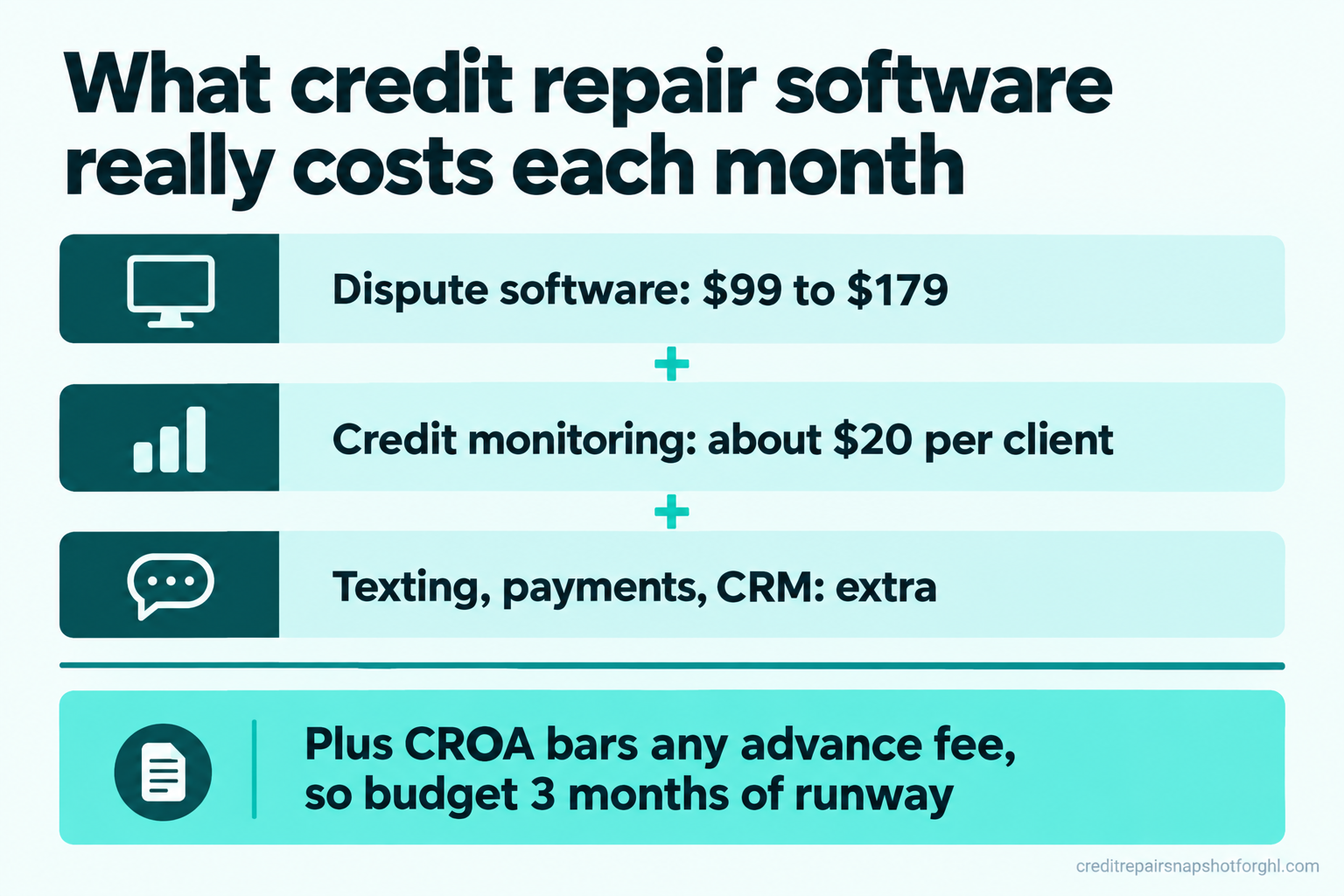
The plan price is the number vendors put on the page. Here are the three that decide your actual margin.
Credit report pulls and monitoring
Every enrolled client needs their three-bureau report pulled and monitored so you can see changes and build rounds. That is not included in your dispute software. It is a separate subscription, and it recurs monthly, per client. IdentityIQ runs from about $6.99/mo on its entry plan up to $29.99 for daily three-bureau monitoring (SafeHome), and SmartCredit runs $19.95/mo for its Basic plan and $29.95/mo for Premium three-bureau (SmartCredit).
Monthly credit-monitoring cost per client (2026). Whether you or the client pays it, this recurs for every enrolled file. Sources: SafeHome (IdentityIQ), SmartCredit.
Multiply that by your client count. Twenty clients on a $20 monitoring service is about $400 a month, well over double your $129 software bill. Most firms have the client subscribe to the monitoring service directly, which keeps it off your books and is cleaner for CROA, but you still have to build that step into onboarding or your import breaks.
The A2P 10DLC texting wall
This is the cost that ambushes almost every new operator. You will want to text clients: reminders, progress updates, payment nudges. To send business texts in the US you must register your campaign under A2P 10DLC, and here is the trap. Carriers classify credit repair and debt-relief content as prohibited, and a campaign flagged for it can be permanently rejected with no resubmission (Twilio). None of these five dispute tools solves your carrier registration for you. If your texts get blocked, your follow-up dies, and follow-up is what keeps clients paying. We break the whole registration process down in our SMS marketing and A2P 10DLC playbook for credit repair.
Your own runway
Because CROA bars any advance fee (FTC), you fund the first cycle of work for every client before you can bill them. Ten new clients in a month is ten first cycles you paid for out of pocket. Budget three months of operating cash before you expect the recurring revenue to carry you. This is the line item that closes shops, and no software has a plan tier for it.
Steal this: your real cost worksheet
Do not price these tools off the marketing page. Price them off this. Fill it in for any tool you are considering and compare the bottom lines, not the top ones.
MONTHLY REAL COST WORKSHEET  (one tool, your client count)

A. Software plan (the tier you ACTUALLY need) .......... $______
B. Extra user seats or client blocks .................. $______
C. Credit monitoring  (clients x per-client fee) ...... $______
D. Texting/phone (A2P-registered SMS + calls) ......... $______
E. Payment processing (~2.9% + 30c per charge) ........ $______
F. Any separate CRM / scheduling / email tool ......... $______
                                              --------------
   TRUE MONTHLY COST  (A+B+C+D+E+F) .................... $______

ONE-TIME / RUNWAY
G. First-cycle float: new clients this month x your
   fee, that CROA bars you from collecting yet ......... $______
Two lines matter most and neither is on any vendor’s pricing page: C (monitoring) is usually bigger than A, and G (float) is the one that empties your account. When a salesperson quotes you “$129 a month,” what they mean is line A. Your real number is the total, and it is often three to four times higher.
And here is a compliant sales line to keep on hand, because the fastest way to lose everything is to promise a result. Never say “we will delete that” or “we guarantee you’ll hit 700.” Say this instead:
“Here is exactly what we do each month: we review your reports, we dispute the items you flag with the bureaus and furnishers, and we keep you updated as they respond. We can’t and won’t promise a specific score or that any single item comes off, because under federal law no honest firm can. What we promise is the work, done on schedule, every month.”
That language keeps you inside CROA’s ban on guaranteed-results claims (FTC) while still telling the client what they are paying for. For the full intake and disclosure flow, use our CROA-compliant client onboarding checklist.
Common objections, answered
“I already pay for Credit Repair Cloud. Should I switch?”
Probably not just to save $50. Switching dispute tools means migrating client files, re-learning a UI, and risking a gap in service, and none of that adds a dollar of revenue. Switch only if a specific thing is broken: you have outgrown your tier and the next one is painful, the training you are paying for is content you no longer need, or you keep bolting on separate tools because CRC does not do CRM. If it is just price envy, put that energy into your follow-up instead. We walk through the migration math in build vs buy your GoHighLevel setup and the move itself in migrating a credit-repair business to GoHighLevel.
“Isn’t the cheapest one always the best pick for a solo op?”
No, and this is the trap. Cheapest on the sticker is often most expensive in total, because the money you save on the plan is dwarfed by monitoring, texting, and the CRM you end up buying anyway. A $99 dispute tool that forces you to run client communication in three other apps costs you more than a slightly pricier tool that keeps it together. Judge total cost and time-to-first-round, not the plan price.
“Do I need to be technical to run any of these?”
No. All five are built for non-technical operators, and Client Dispute Manager and Credit Repair Cloud specifically include onboarding to get you moving. The technical wall is not the dispute software. It is A2P 10DLC registration and wiring your monitoring imports, and that is exactly the part these tools leave to you. If any part of this stack needs a hand, that is the part.
“Why would I add GoHighLevel on top of a dispute tool?”
Because the dispute tool and your business system are two different jobs. The five tools here generate and track letters. They do not reliably answer your phone, run automated CROA-safe onboarding, handle recurring billing with dunning, or win back a client who went quiet. That operational layer is where clients actually churn, and it is what our recurring billing without chargebacks playbook and the broader CRM and workflow automation build are about. Many operators keep a lean dispute tool and run everything else on GoHighLevel. See our full credit-repair pricing breakdown for how that stacks up.
Frequently asked questions
Best credit repair software for solo operators: FAQ
What is the cheapest credit repair software that a real business can use?
For a functioning business, the cheapest capable options are Client Dispute Manager from about $99/mo and DisputeBee Business at $129/mo, with ScoreCEO from $149/mo. Credit Repair Cloud's $49 Personal plan is cheaper but caps at 3 active clients, so its real business entry price is the $179 Start plan. Remember that credit monitoring is billed separately per client on top of any of these.
Why is Credit Repair Cloud so popular if it costs more?
Because it sells training and community, not just software. For a total beginner who has never sent a dispute letter, that hand-holding is worth the premium at the start. The trade-off is that its price ladder climbs steeply ($179 to $399 to $599) as you add clients and users, so many operators outgrow the value and move to a cheaper tool once they know what they are doing.
Why won't DisputeFox show me a price without a demo?
DisputeFox gates its full tiers behind a sales call. Reported figures put its entry around $108 to $129 a month with 100 client slots per user, but you will not see confirmed pricing until the demo. For a solo operator comparison-shopping quickly, that friction is a real drawback, even though the product itself is one of the most all-in-one on the list.
How much does credit monitoring add on top of the software?
Every enrolled client needs a report pulled and monitored, and that is a separate subscription from your dispute software. IdentityIQ starts around $6.99/mo and SmartCredit around $19.95/mo per client, rising to about $29.95 for full three-bureau monitoring. Twenty clients on a $20 service is about $400 a month, which is typically larger than your software bill. Most firms have the client subscribe directly.
Can I charge clients an upfront setup fee to cover my costs?
No. CROA prohibits charging or collecting any fee before the service is fully performed, and there is no exception for a fee labeled setup, enrollment, or administrative. You must complete the work first, then bill. Plan for roughly three months of runway to cover the client work you are funding before that recurring revenue catches up.
Will these tools handle my client texting and calls?
No. The five dispute tools focus on letters and file management. Business texting in the US requires A2P 10DLC registration, and carriers frequently reject credit-repair and debt-relief content, sometimes permanently. You handle that registration and your phone coverage separately, which is one reason many operators run a dedicated CRM alongside their dispute tool.
Does any single tool replace my whole tech stack?
Not cleanly. DisputeFox and ScoreCEO come closest by bundling a CRM with the dispute engine, but you still need monitoring, compliant texting, payment processing, and scheduling. Most solo operators end up with a dispute tool plus a business system. The realistic question is not which single tool does everything, but which combination costs the least in total for your client count.
About the author
Marcus Pennington advises credit-repair business owners and the agencies that serve them on the unglamorous side of growth: keeping clients enrolled and paying past month three. A former SaaS churn analyst, he reverse-engineers cancellation triggers and builds the billing, dunning, and win-back logic that protects monthly recurring revenue without ever overpromising a result. He is allergic to hype and partial to a clean cost worksheet.
Sources
- Credit Repair Cloud, pricing plans and client limits: creditrepaircloud.com/pricing
- DisputeBee pricing (Individual and Business): Investographer, SoftwareSuggest
- ScoreCEO pricing and plans: ScoreCEO, SoftwareSuggest
- Client Dispute Manager pricing: Capterra, GetApp
- DisputeFox pricing (reported): SaaSworthy, SoftwareSuggest
- Credit monitoring cost per client: SafeHome (IdentityIQ), SmartCredit
- US credit-repair number of businesses, 2025: IBISWorld
- US credit-repair market size, 2025: IBISWorld
- Average US credit score and subprime share: Experian
- Credit Repair Organizations Act (advance-fee ban, written contract, cancellation): FTC
- A2P 10DLC prohibited content (credit repair / debt relief): Twilio error 30949