

It is the morning your client’s results come back. You worked the file, wrote the dispute, mailed it certified, and waited out the clock. The response lands in two words: “verified as accurate.” The collection is still on the report, and an hour later the client texts asking what happened. You do not have a clean answer.
That moment is the most demoralizing part of running a credit-repair shop, and it happens more than anyone admits. Here is what matters: most rejections are procedural, not a verdict on whether you were right. Once you know the reason, you know the fix.
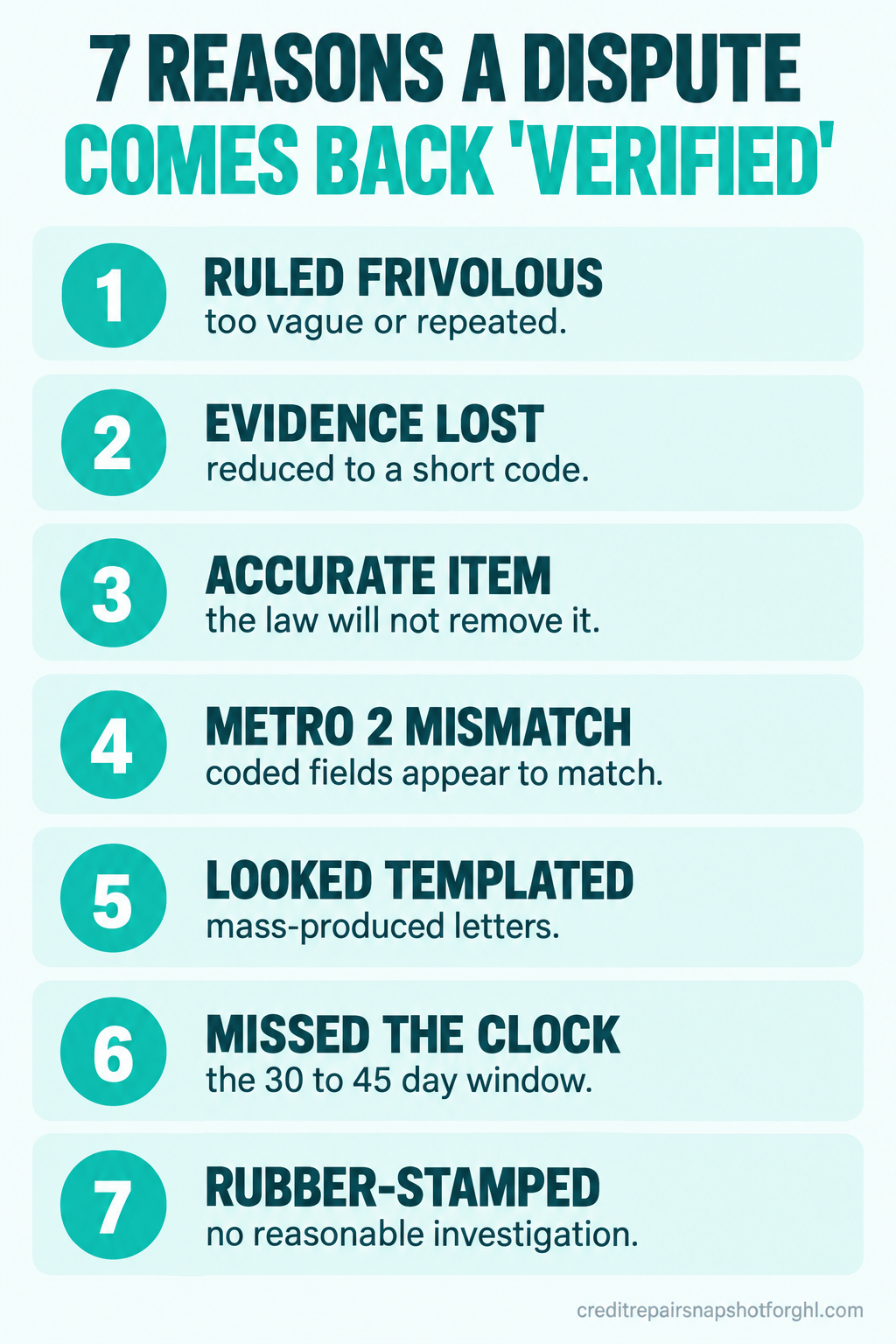
The short version: credit bureaus reject or stall dispute letters mostly for procedural reasons, not factual ones. A dispute gets ruled frivolous, or gets crushed down to a three-digit code before it ever reaches the furnisher, or targets accurate information the law will never remove, or misses a Metro 2 data mismatch, or looks mass-produced, or dies because nobody tracked the clock. This guide walks each one and its fix.
One line before we start: this is about process, not outcomes. Nothing here disputes an item for you or promises a deletion or a score change. You are the credit-repair organization; your job is to make each dispute procedurally sound and keep the client calm while you rework the bounces.
Table of contents
- What happens to a dispute after you send it
- The 7 reasons disputes get rejected or stalled
- Handle a rejection the same way every time
- The same problem at three shop sizes
- The compliance line you cannot cross
- Objections
- FAQ
What happens to a dispute after you send it
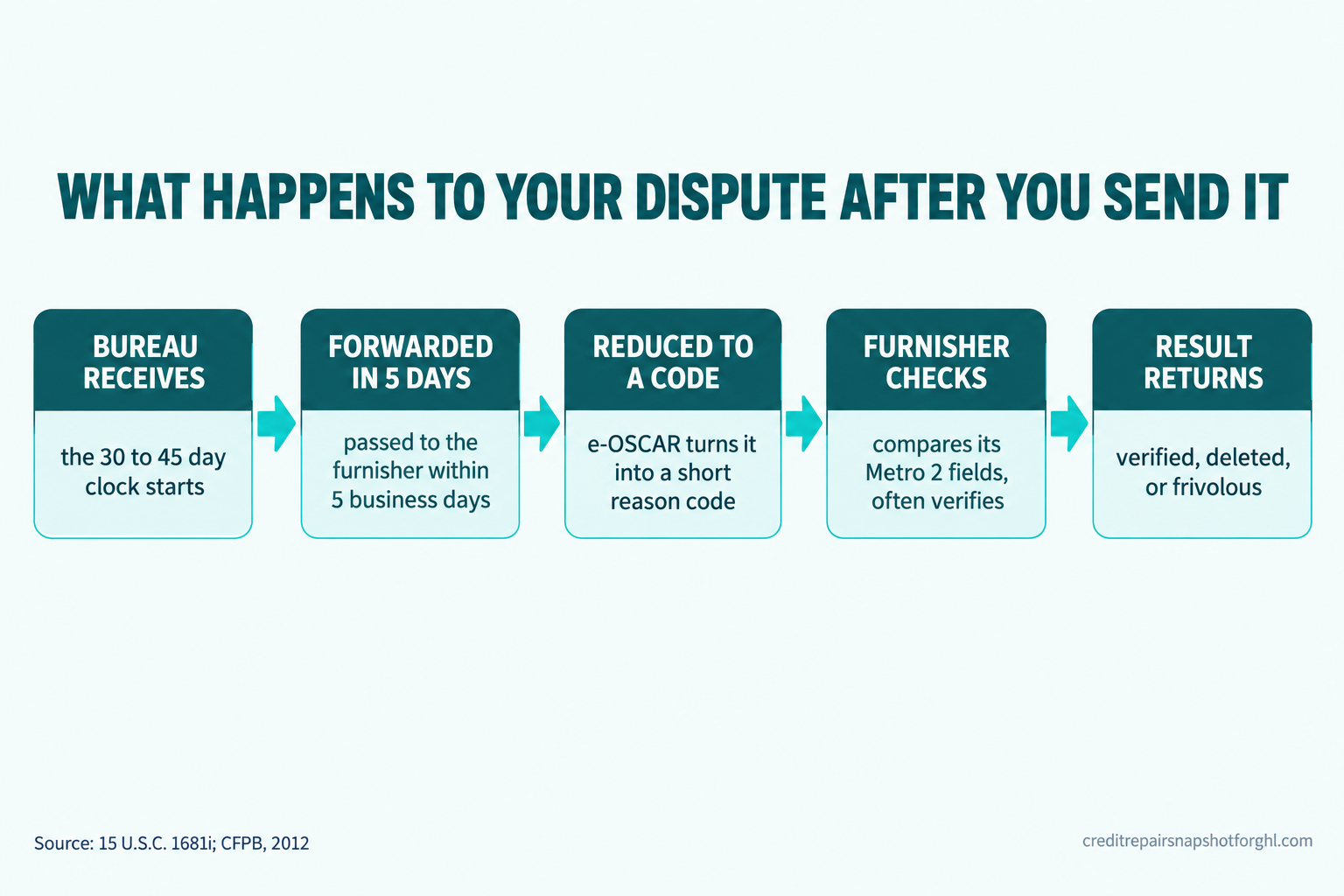
To fix a rejection you have to know what your letter goes through. It is not a person reading your argument. It is a pipeline.
When a bureau receives a dispute, it has to run a reasonable reinvestigation, free of charge, within 30 days, stretching to 45 if the consumer sends more relevant information during the first 30. It also has to pass the dispute to the furnisher, the bank or collector that reported the item, within 5 business days (15 U.S.C. §1681i). The furnisher then has to investigate, review what the bureau sent, and correct anything inaccurate, incomplete, or unverifiable (15 U.S.C. §1681s-2).
Here is the trap. Bureaus route disputes through an automated system called e-OSCAR, using a short form called an ACDV. The CFPB found that bureaus “simply reduced everything submitted by the consumer to a three-digit code,” and that the system “did not provide a means for credit reporting companies to forward to furnishers any documents submitted by consumers” (CFPB, 2012). It was later upgraded to send mailed-in documents, but the core risk stands: your careful three-paragraph argument can reach the furnisher as a short reason code.
So the furnisher checks its records, sees they match the code, and stamps “verified.” The scale shows how routine this is: in 2025 about 5.8 million of the CFPB’s 6.6 million complaints, roughly 88%, were about credit or consumer reporting (CFPB, 2025). The machine is fast, but not the same as correct.
The 7 reasons disputes get rejected or stalled
Read the list below as a diagnostic. When a dispute bounces, walk it and you will find the cause.
Reason 1: The bureau ruled it frivolous or irrelevant
What it is. The bureau does not have to reinvestigate every dispute. If it “reasonably determines that the dispute is frivolous or irrelevant,” including when a consumer fails to provide sufficient information, it can close the file and tell the consumer within 5 business days what it needs (15 U.S.C. §1681i).
Why it happens. Vague disputes invite it. “This account is not mine” with no identification or reason reads as boilerplate, as does a letter that repeats last round’s wording. The bureau sees nothing new and closes the file.
The fix. Make every dispute specific enough that “frivolous” is not defensible. Name the account, the exact field you say is wrong, and the reason in the client’s own situation, and include their identification. If one already came back frivolous, do not resend it. Add the specific information the notice asked for and send it as new, relevant information, which also opens the 15-day extension in the client’s favor.
Reason 2: Your evidence never reached the furnisher
What it is. You wrote a strong argument, attached proof, and it still verified. This is the three-digit-code problem: the bureau condensed your dispute into a short e-OSCAR code and, historically, did not pass your documents at all (CFPB, 2012). The furnisher checks its file against the code, sees a match, and confirms.
Why it happens. The channel is built for speed, not nuance. A paragraph explaining that a payment posted late because of a documented bank error can land as a generic “disputes account information” code. The furnisher never sees the bank error, so nothing forces a change.
The fix. Assume the code is all that travels, and dispute at the field level so it carries meaning. Instead of “this account is wrong,” dispute “the 30-day late reported in March is inaccurate; the payment posted on time.” Mail supporting documents, and consider a parallel dispute straight to the furnisher under 15 U.S.C. §1681s-2 so the evidence reaches the party that decides. Monitoring the report lets you catch the response the day it posts (connect credit monitoring to your CRM).
Reason 3: You disputed accurate information
What it is. Some items never come off because they are accurate and current. The reinvestigation only requires deletion when information is inaccurate, incomplete, or unverifiable. Accurate negative data stays.
Why it happens. This is where the “609 letter” myth does real damage. Templates sold online promise that a Section 609 request forces deletion through a paperwork loophole. It does not. Section 609 is a disclosure right: it lets a consumer get their file and its sources, and carries no power to delete anything (15 U.S.C. §1681g). Deletion happens only through the §611 reinvestigation, and only when the item is wrong or cannot be verified.
The fix. Screen every account before you dispute it. Accurate, timely negative information reports for 7 years, bankruptcy for up to 10 (FTC). If an item is accurate and inside that window, a dispute wastes a round and trains the bureau to see your client as a serial disputer. Spend rounds on genuine inaccuracies: wrong balances or dates, duplicates, accounts that are not the client’s, items past the reporting window. That is where the law is on your side, and where you set expectations before a failed round, not after.
Reason 4: A Metro 2 data mismatch verified it
What it is. Furnishers report to the bureaus in a standardized data format called Metro 2, developed in 1997 by the Consumer Data Industry Association and updated yearly in the Credit Reporting Resource Guide (CDIA). Every account is a set of coded fields: status, dates, balance, payment history, the dispute flag. The investigation largely compares those fields.
Why it happens. When you dispute in general terms, the furnisher checks whether its Metro 2 fields match what it reported and says “verified.” It never has to reconcile fields that contradict each other. A date of last activity that keeps moving, or a balance that does not match the payment grid: those inconsistencies are the strongest disputes, and a vague letter walks past them.
The fix. Dispute the specific field that is inconsistent or provably wrong, and say what the correct value is. “The date of first delinquency is missing” or “the balance does not match the payment history” gives the furnisher a data point it has to defend, not a general objection it can wave through. Field-level disputes are harder to rubber-stamp because a coded system cannot pretend an inconsistency is consistent.
Reason 5: The letter looked mass-produced
What it is. Bureaus and furnishers can spot template language. Identical letters, phrases copied from “credit repair secrets” packets, and bulk disputes with the same structure all raise the odds of a frivolous ruling or a fast verification.
Why it happens. The tell is uniformity. If a hundred disputes use the same three sentences, the pattern is obvious, and the most-shared template phrases signal a paid preparer rather than a consumer describing a real error.
The fix. Original, factual, client-specific letters. Describe the client’s actual situation, cite the specific account and field, keep the tone plain. You can work from a strong base structure; you just fill it with real detail so no two disputes read the same. This is where operations help without touching the substance: the system holds your framework and merges each client’s real facts, while a human writes the reason. The round pacing is in automating dispute rounds without losing compliance.
Reason 6: Nobody tracked the clock
What it is. A dispute is not just an argument, it is a deadline. The bureau owes a result in 30 days, or 45 with a qualifying extension (15 U.S.C. §1681i). Untracked, a stall quietly becomes a dead dispute you never follow up.
Why it happens. Volume. One client is easy to watch. Forty clients, each with three or four accounts in different rounds, is impossible to hold in your head or a hand-updated spreadsheet. This is one of the bottlenecks in why you cannot scale past 50 credit-repair clients.
The fix. Put the clock in a system, not your memory. Every dispute gets a sent date, a due date, and an automatic task when the window closes. Silence matters too: information that cannot be verified within the window is supposed to be deleted, so a non-response is a follow-up you make on time, not a month late. The CRM and workflow layer turns the clock into tasks that fire on their own.
Reason 7: The furnisher rubber-stamped the investigation
What it is. Sometimes the furnisher reconfirms what it already reported without a real review. The CFPB has been explicit that both bureaus and furnishers must conduct a reasonable investigation, and that a boilerplate or parroting response can violate the law (CFPB Circular 2022-07).
Why it happens. The automated pipeline makes reconfirming the cheapest option. If the coded fields match, the path of least resistance is to verify and move on, even when a real look would tell a different story.
The fix. When you believe the investigation was not reasonable, do not resend the same dispute. Escalate with new, specific information: the document that contradicts the reporting, a request for the method of verification, or a direct dispute to the furnisher. Keep a clean paper trail of every round, because an audit trail supports a reasonable-investigation argument and, if it comes to it, a complaint or an attorney referral. You are documenting the process, not giving legal advice.
Handle a rejection the same way every time
The firms that grind through rejections without burning out treat a “verified” as a step, not a surprise. That takes a standard procedure your team runs every time, plus client communication that keeps people calm.
The client message is the part most shops skip, and it is why people cancel. A client who hears nothing assumes you failed; one who gets a calm, honest update stays enrolled. Sent the day the result posts, factual and free of any promise, it beats any discount for retention, and a client-progress-update workflow fires it on time.
The same problem at three shop sizes
The seven reasons do not change as you grow. Where rejections hurt does.
Solo operator, under 30 clients. You can still diagnose every rejection by hand, so the risk is emotional. A run of verified results feels like personal failure. The fix is the diagnostic mindset: treat each “verified” as one of seven known causes with a known next step, and the grind stops feeling random.
Two-person shop, 30 to 80 clients. Now the clock is the enemy. With two people onboarding, disputing, and answering clients, deadlines scatter, and a shared system of record stops being optional. Everyone logs results the same way and no rejected dispute goes quiet for three weeks.
Small team, 80 clients and up. Here the failure is inconsistency across people. One writes field-level disputes; another sends templates that get flagged. The fix is standardization: one framework, one procedure for rejections, one dashboard where every dispute’s status is visible. The substance still comes from a human; the process is identical.
The compliance line you cannot cross
Working rejections harder is fine. Crossing into prohibited territory is how firms get sued or shut down. Three CROA rules sit over everything above.
Never advise a false statement. You cannot make, or counsel a client to make, any statement to a bureau or creditor that is untrue or misleading about their credit (15 U.S.C. §1679b). Telling a client to claim an account is not theirs when it is, is exactly what CROA prohibits. Every dispute has to rest on a real inaccuracy.
Never charge before the work is done. CROA bars charging for a service before it is fully performed (15 U.S.C. §1679b), and your contract must be written and signed with the required disclosures and a three-business-day cancellation right (15 U.S.C. §1679d, §1679e). The CROA-compliant onboarding checklist files all of this automatically.
Never promise an outcome. No deletion, no score number, no guarantee. You run a documented, good-faith dispute process; the result depends on the facts and the bureaus. A system helps you run the process cleanly and prove you ran it. It does not, and must not, promise a result.
Objections
“Isn’t a 609 letter the secret nobody tells you about?” No. Section 609 is a disclosure right, not a deletion tool (15 U.S.C. §1681g). Deletion comes only from a §611 reinvestigation when an item is inaccurate or unverifiable.
“The bureau is just lazy, so I will resend the same letter.” Resending an identical dispute is the fastest way to a frivolous ruling, because the bureau sees nothing new. Every resend needs new, specific information, which also opens the extension window and forces a real look.
“Should I just dispute everything at once?” No. Blasting the whole file, accurate items included, marks your client as a serial disputer and invites frivolous rulings. Screen first, dispute only genuine inaccuracies, and you are taken seriously.
“Do I really need software for this?” For one client, no. For a caseload, yes, because the failures at volume are tracking failures: missed deadlines, lost follow-ups, clients who cancel. The disputes are still yours to write; the system keeps them from slipping.
Frequently asked questions
Why did my dispute come back 'verified as accurate' when I know it's wrong?
Usually because the furnisher only matched its coded records to a short dispute code. The CFPB documented that bureaus historically reduced disputes to a three-digit code and did not forward consumer documents (CFPB, 2012). Dispute the specific inaccurate field, include supporting documents, and consider a direct dispute to the furnisher.
Is a 609 letter a real way to force deletion?
No. Section 609 (15 U.S.C. §1681g) is a disclosure right that lets a consumer obtain their file and its sources. It has no deletion power. Deletion happens through the §611 reinvestigation, only when information is inaccurate, incomplete, or unverifiable.
Can accurate negative information be disputed off a report?
No. A dispute only requires removal of information that is inaccurate, incomplete, or unverifiable. Accurate negative information can stay for its legal window, generally 7 years and up to 10 for bankruptcy (FTC).
What should I do when a dispute is ruled frivolous?
Do not resend the same letter. A frivolous determination usually means the bureau saw no specific, sufficient information (15 U.S.C. §1681i). Add the exact detail the notice asked for, name the account and field, include the client's identification, and send it as new, relevant information.
Does this system dispute items or fix credit for me?
No. It runs the operations around your dispute work: logging results, diagnosing rejections, tracking the reinvestigation clock, firing follow-up tasks, and keeping clients informed. You remain the credit-repair organization that writes and sends the disputes, and nothing here promises a deletion or a score change.
Back to that Monday morning. With the seven reasons in front of you, that “verified” is no longer a gut punch. It is a diagnosis: you log it, name the cause, prepare the next round with real information, set the follow-up, and send the client a calm update. The disputes are still the hard, human part, and they are still yours. Everything around them, the clock, the tracking, the client’s peace of mind, keeps you sane while you do it.