It is 8:15 on a Tuesday. A lead filled out your form at 11 the night before, so your automation fires the welcome text: “Hi Dana, thanks for reaching out about your credit. When’s a good time to talk?” You never hear back. You assume the lead went cold. What actually happened is that your message never left the building. The carrier looked at your unregistered number, saw a business text, and dropped it silently. No bounce, no error, no warning. Just nothing.
That silence is the single most expensive thing in a credit repair business right now, and almost nobody writes about the reason. Here is the short version, up front: credit repair is a flagged content category for business texting, so the carrier registration system rejects most firms on the first try, and if you never registered at all, your texts are being blocked outright. Since February 1, 2025, the major US carriers block business texts from unregistered numbers entirely (Twilio). Fixing it is not hard, but it is specific, and if you do it the way a generic SMS guide tells you to, you will get denied.
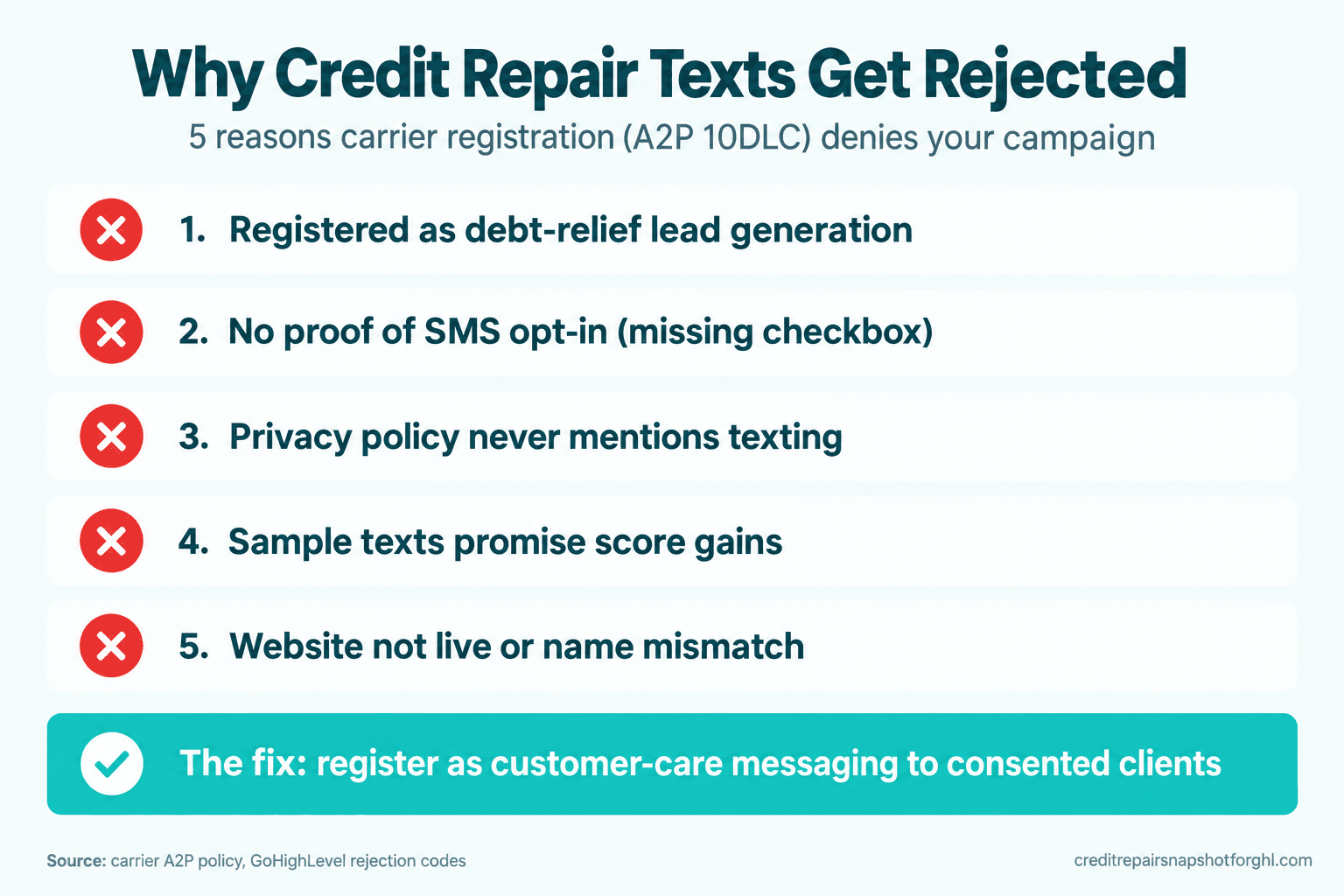
Table of contents
- What “your texts are blocked” is actually costing you
- Why credit repair specifically gets flagged
- The six things that get your campaign rejected
- Rejected vs approved: the same firm, two outcomes
- What this looks like for solo, small team, and agency
- Where CROA and TCPA meet the carrier rules
- Objections and hard questions
- Frequently asked questions
What “your texts are blocked” is actually costing you
Texting is the fastest channel a credit repair firm has. When it silently fails, three things bleed money at once and you often cannot see any of them on a dashboard. Your speed-to-lead dies, because the first text to a fresh lead never lands and whoever texts back first wins the consult. Your no-shows climb, because the cheapest no-show insurance you have is a reminder that arrives. And your enrolled clients go quiet, because the case-progress update that reminds them work is happening never reaches them, and quiet clients cancel around month three.
Registration itself is cheap. Through GoHighLevel, a Sole Proprietor or Low Volume Standard brand runs about $24.50 one-time (bundling brand registration, campaign vetting, and fast-track processing), a High Volume Standard brand about $71.91, with a small monthly campaign fee of roughly $2 to $10 and per-message carrier fees near $0.003 per SMS (GoHighLevel). Each extra campaign adds a $15 vetting fee.
The expensive part is not the fee. It is getting rejected, sitting unregistered for weeks while you figure out why, and losing leads the whole time. Worse, certain rejection codes, including the one for credit repair, are marked “ineligible for standard resubmission” (GoHighLevel). Register the wrong way and you have not just wasted a fee, you have burned a path.
Daily SMS segments you can actually send, by registration status. Unregistered numbers deliver zero business texts to the major carriers. Source: GoHighLevel A2P 10DLC fees.
Why credit repair specifically gets flagged
Here is the part nobody tells you when you sign up for a texting tool. The carriers, through the framework built by The Campaign Registry and the CTIA, keep a list of content that is restricted or prohibited on the A2P (application-to-person) network. High-risk financial services sit near the top of it, and credit repair is named inside, right next to debt settlement, debt consolidation, and loan forgiveness.
You do not have to take my word for it. GoHighLevel’s own rejection documentation publishes the exact error codes: 30950 for “Credit repair services,” 30949 for “Debt reduction or consolidation services,” and 30942 for loan marketing (GoHighLevel). Its approval guidance lists “high-risk financial services,” “debt-related services,” and “third-party lead generation” among prohibited categories (GoHighLevel).
Why so harsh? This content category has a long history of scams, and the carriers would rather block a thousand legitimate firms than let one smishing operation loose on their subscribers. The word “credit repair” in a campaign, paired with promotional lead-generation language, reads to the vetting system exactly like the debt-relief operations it is built to stop. You are judged by the company your keywords keep.
But there is a door, and it is a legitimate one. The prohibition targets debt-relief lead generation and promotion. Messaging between a business and its own existing, consented customers about their account is treated differently. When you text a client who signed your agreement to say a dispute round was mailed, or to confirm the appointment they booked, that is customer-care and account-notification messaging. It is transactional, not a promotional offer to a stranger. Registering accurately for the messaging you actually send, to people who actually opted in, is the whole game.
The six things that get your campaign rejected
Most rejections are not about the credit repair flag at all. They are mechanical failures any campaign can trip over, and GoHighLevel documents each with its own error code. Fix these six and you remove almost every reason a reviewer has to deny you. Read forward through them and you are also reading the approval path in order.
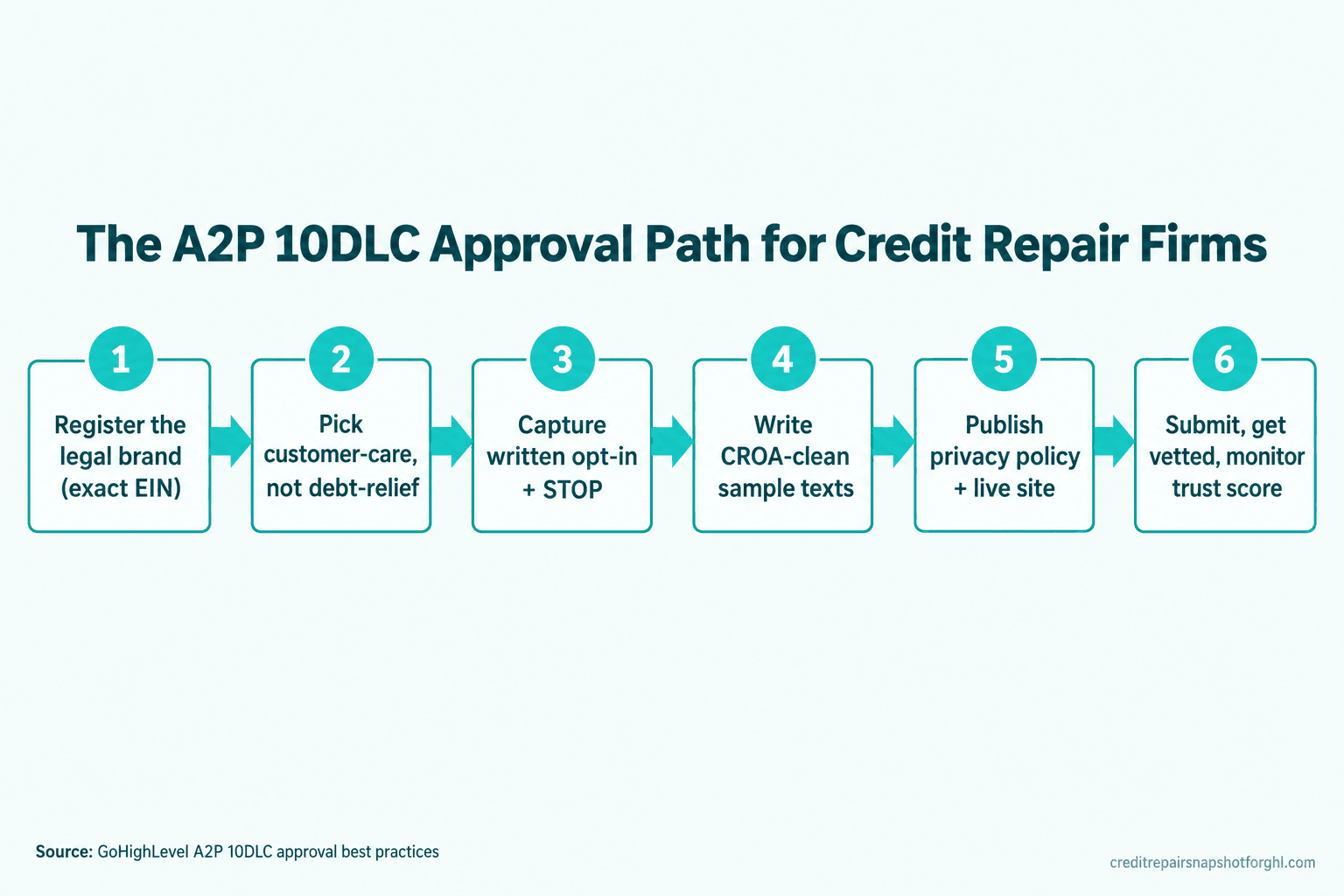
1. Your brand details do not match your EIN
Brand registration is checked against public tax records. The legal name, EIN, and address must match what the IRS has on file exactly. A DBA in the name field, a typo in the EIN, or last year’s address is an instant kickback. Pull your EIN confirmation letter and copy it character for character, then put the brand name customers know in the campaign, not the brand record.
2. You picked a use case that describes debt relief
This is the credit-repair-specific killer. When the campaign asks what you are sending, the safe answer for most firms is customer care and account notifications: appointment reminders, case-status updates, billing notices, and replies to clients who text you first. Select a marketing or lead-generation use case, fill it with debt-relief language, and you have handed the reviewer the prohibited pattern. Describe the transactional messaging you actually send to enrolled clients, and keep cold-lead marketing off SMS entirely.
3. You have no proof of how people opt in
Consent is the number one thing reviewers want, and “we get consent” is not an answer. They want the mechanism: a web form with an unchecked SMS checkbox, the exact wording beside it, and where the number is collected. GoHighLevel flags this as code 30925 (“opt-in form is missing a checkbox, or the checkbox is pre-selected”) and 30924 (consent language missing “message and data rates may apply” and STOP instructions). Put a real, unchecked checkbox on your intake form: “I agree to receive account and appointment texts from [Firm]. Msg & data rates may apply. Reply STOP to opt out.” Then describe it word for word in the campaign.
4. Your privacy policy does not mention texting
Reviewers open your privacy policy and look for two things: that you collect phone numbers for messaging, and that you do not sell or share mobile opt-in data with third parties for marketing. Code 30932 fires when a policy “indicates opt-in data is shared with third parties for marketing,” and a policy that never says the word “text” gets flagged too. Add a short SMS section, state that mobile numbers are not shared or sold, and link to it from your opt-in form.
5. Your sample messages read like a pitch
You must submit sample messages, and they have to match your use case and stay clean. Code 30893 fires when samples “do not match the campaign use case,” and 30892 when they include a public URL shortener or a non-secured link. Promotional, urgency-driven, or outcome-promising samples get rejected on content, and in credit repair, outcome promises are also a CROA violation. Submit the boring, useful, transactional texts you actually send.
6. Your website is not live, or does not match
The vetting system visits your website. Code 30919 fires when a site “lacks sufficient business information or messaging disclosure,” and 30921 when it “requires a login” so reviewers cannot see it. A parked domain, a coming-soon page, or a business name that does not match your brand record is a rejection. Get the site live first. If you need one fast, a conversion-ready credit repair website with the opt-in form built in removes this failure point before you ever submit.
Rejected vs approved: the same firm, two outcomes
The difference between a denied campaign and a cleared one is rarely the business. It is how the business is described and what the messages say. Here is the same firm registered two ways.
What a reviewer sees
| Plan | The campaign that gets rejected | The campaign that gets approved recommended |
|---|---|---|
| Price | Denied | Cleared |
| Feature 1 | Use case: marketing / lead generation | Use case: customer care / account notifications |
| Feature 2 | Description: "credit repair offers and promotions" | Description: "appointment and case-status texts to enrolled clients" |
| Feature 3 | Sample: "Erase bad credit fast! Reply YES" | Sample: "Hi [Name], your [Firm] round 2 was mailed today." |
| Feature 4 | Consent: "collected on our website" (nothing visible) | Consent: unchecked SMS checkbox on intake form, wording shown |
| Feature 5 | Privacy policy: no mention of SMS | Privacy policy: SMS section, no data sold or shared |
| Feature 6 | Audience: purchased and cold lead lists | Audience: clients who signed an agreement and opted in |
| Feature 7 | Website: coming-soon placeholder | Website: live, business name matches the brand record |
| Feature 8 | Result: flagged as prohibited debt-relief content | Result: transactional messaging, cleared for delivery |
Same company, same product, completely different outcome. The rejected firm is describing debt-relief lead generation. The approved firm is describing account care for people who already hired it. The task is not to trick the system. It is to register for the messaging you should be sending anyway, because the CROA-clean, non-promotional, consented approach is also the compliant one.
Here is a small library of texts that read as account care and stay inside CROA. Swap the brackets for your merge fields and use them as your registration samples and your real sends.
- Lead reply: “Hi [Name], this is [Firm] returning your message about your credit file. When is a good time for a quick call? Reply STOP to opt out.”
- Appointment confirm: “You’re booked with [Firm] on [Date] at [Time]. Reply C to confirm or R to reschedule.”
- Reminder: “Reminder: your [Firm] consultation is tomorrow at [Time]. See you then. Reply STOP to opt out.”
- Case update: “Hi [Name], an update on your file: round [N] was prepared and mailed on [Date]. We’ll let you know when we hear back. Results vary by item and bureau.”
- Billing notice: “Hi [Name], your monthly [Firm] payment of [Amount] processes on [Date]. Questions? Just reply here.”
- Review request: “Glad we could help this month, [Name]. Would you share a quick review of your experience? [link] Reply STOP to opt out.”
None of them promise a deletion or a score jump, none create false urgency, and every one names the firm and offers a way out. That is the same discipline that keeps you clear of CROA and the carriers at once.
What this looks like for solo, small team, and agency
The registration path is the same for everyone, but the right brand type and the failure points shift with your size.
The solo operator. One person, a sole proprietorship or single-member LLC, texting a few hundred clients. Register as a Sole Proprietor or Low Volume Standard brand. Your throughput ceiling, thousands of segments a day, is far more than you will use, so do not overpay for a high-volume brand. Your real risk is the boring stuff: a privacy policy you never updated and an opt-in checkbox you never added. If the paperwork makes your eyes glaze over, hand it to a trained GoHighLevel VA who has done registrations before.
The small team. Two to five staff, a few thousand clients, almost certainly a Standard brand. You may run more than one campaign, for example a customer-care campaign for client updates and a low-volume conversational campaign for consultations, and each extra campaign carries the $15 vetting fee. Your risk shifts to consistency: five people texting from templates they wrote themselves will eventually send something promotional that gets you flagged. Lock the templates down and route everything through approved workflows.
The agency or reseller. You manage texting for multiple credit repair clients, each a separate legal entity. Every client needs its own brand registration under its own EIN. You cannot text one client’s contacts under another client’s brand, and you cannot register them all under your agency. Your risk is scale: one client’s sloppy content can damage the shared trust reputation of numbers on your platform. Vet clients like a carrier would, standardize the compliant templates, and keep registration, consent, and messaging in one system per sub-account on GoHighLevel. (That link is our GoHighLevel partner referral; we may earn a commission at no extra cost to you.)
Where CROA and TCPA meet the carrier rules
A2P registration is one of three rulebooks you play under at once, and they overlap in a way that helps you. Do the right thing once and you satisfy all three.
The Credit Repair Organizations Act (CROA) governs what you can say and when you can charge. It bans charging any fee before services are fully performed, requires a written contract with a three-business-day cancellation right, and prohibits claims that you can “erase accurate negative information” or guarantee a result (FTC, 15 U.S.C. 1679b). Each of those is also a texting best practice: a message that promises a score jump violates CROA and gets rejected for outcome-promising content. The compliant text and the deliverable text are the same text.
The Telephone Consumer Protection Act (TCPA) governs consent. It requires prior express written consent before marketing texts, honoring opt-outs immediately, and respecting quiet hours, with statutory damages of $500 per text and up to $1,500 for willful violations (FCC). The consent proof the TCPA requires is the same opt-in record the carriers demand at registration. Capture it once, correctly, and you have both. The carrier rules then want registration, honest content, and documented consent, which is what the other two already require.
That clean setup also raises your carrier trust score, which sets how fast you can send.
Message throughput (SMS per second) for a Standard brand by trust score. A clean brand record, real consent, and honest content raise your score and your throughput; a shaky one throttles you to a trickle. Source: GoHighLevel: message throughput and trust scores.
Getting the language right is worth doing carefully once. Our compliance-first onboarding checklist covers consent capture in detail, and the broader SMS marketing playbook walks through the messaging program that sits on top of a registered number.
Objections and hard questions
“I already pay for a texting tool, doesn’t it handle this?” Your tool provides the pipe and submits the paperwork. It does not write your privacy policy, choose your use case, or clean up your samples, and it will happily submit a campaign that gets rejected. The registration decisions are yours. The tool that makes this easiest is one where consent capture, templates, and sending live in the same place, which is the argument for running the whole thing on GoHighLevel rather than stitching a texting app to a separate CRM.
“Won’t clients find automated texts annoying?” Account-care texts are the ones clients actually want. Reminders and case updates cut the “what’s happening with my file?” calls that eat your day. Annoyance comes from promotional blasts to people who did not ask, which is exactly the messaging that also gets you rejected. The compliant path and the client-friendly path are the same path.
“Can I just use my personal cell or an app that skips registration?” For a while, until the carriers filter you. Since February 2025 unregistered A2P traffic is blocked, and grey-route workarounds get numbers banned and can land you on a bad-actor list that follows you. There is no durable shortcut.
“What if I get rejected anyway?” Rejections come with a reason code. Read it, fix the specific thing, and resubmit. It is usually one of the six failures above, most often consent proof or the use case. Rejection is a step in the process, not a verdict on your business. What you cannot afford is to give up and keep operating unregistered while your texts vanish.
Frequently asked questions
Why do credit repair A2P 10DLC campaigns get rejected?
Because credit repair is a flagged, high-risk financial content category, grouped with debt settlement, debt consolidation, and loan forgiveness. Carrier policy prohibits campaigns that promote or solicit debt-relief services, and GoHighLevel documents a specific rejection code for it (30950, 'Credit repair services'). Beyond that content flag, most rejections are mechanical: missing opt-in proof, a privacy policy that never mentions texting, promotional sample messages, or a website that is not live.
Can credit repair companies legally send text messages at all?
Yes. The prohibition targets debt-relief lead generation and promotional solicitation, not communication between a firm and its own enrolled, consented clients. Texting clients who signed your agreement about their appointments, case status, and billing is customer-care and account-notification messaging, a legitimate registered use case. You still must register for A2P 10DLC, capture written consent under the TCPA, and keep content clean under CROA.
What is A2P 10DLC and do I have to register?
A2P 10DLC is the system for registering application-to-person business texting sent from a standard 10-digit number in the US. You enroll your brand (your legal business) and each campaign with The Campaign Registry. Since February 1, 2025, AT&T, T-Mobile, and Verizon block texts from unregistered numbers, so registration is effectively mandatory to have your texts delivered.
How much does A2P 10DLC registration cost for a small firm?
Through GoHighLevel, a Sole Proprietor or Low Volume Standard brand is about $24.50 one-time (bundling brand registration, campaign vetting, and fast-track processing), with a monthly campaign fee of roughly $2 to $10 and per-message carrier fees near $0.003 per SMS. Each additional campaign adds a $15 vetting fee. The cost is small; the expensive part is getting rejected and operating unregistered while your texts are blocked.
What can a credit repair text say without violating CROA or getting blocked?
It can confirm an appointment, remind a client of a booking, report that work was performed such as a round being prepared or mailed, prompt a payment update, and ask for a review. It cannot guarantee a deletion, promise a score increase, claim to erase accurate negative information, or imply your firm is the consumer's legal agent. Describe process and effort, never a promised outcome. The same clean language keeps you clear of CROA and least likely to be filtered by carriers.
How long does approval take, and what if I'm rejected?
Brand registration is often near-instant, and standard campaign vetting usually takes a few business days, though credit-repair-adjacent content can draw extra scrutiny. If you are rejected, you get a reason code. Read it, fix the specific issue (most often consent proof or an inappropriate use case), and resubmit. Rejection is a normal step, not a permanent denial, as long as you register accurately for account-care messaging and keep content compliant.
About the author
Simone Braxton is a GHL Automation Strategist for credit repair operations. She spent eight years running back-office operations for credit-repair firms before moving full-time into GoHighLevel implementation, and she specializes in turning onboarding, consent capture, and client follow-up into repeatable workflows that keep firms inside CROA and carrier guardrails while cutting the manual work that burns out small teams. Simone is a fictional editorial persona used for authorship attribution. Her articles are operational guidance, not legal or financial advice. Confirm your registration and compliance setup with your own counsel and your messaging provider.
Related reading
- The compliance-first SMS marketing playbook for credit repair
- A CROA-compliant client onboarding checklist
- Score-milestone texts that keep clients paying
- Reduce no-shows on credit repair consultations
Sources
- GoHighLevel: A2P campaign rejection reasons and required fixes (error codes 30950 credit repair, 30949 debt reduction, 30942 loan marketing, and the consent, privacy, sample, and website codes).
- GoHighLevel: A2P 10DLC campaign approval best practices (prohibited categories).
- GoHighLevel: A2P 10DLC messaging fees (registration and carrier fees).
- GoHighLevel: message throughput and trust scores (throughput by trust-score tier).
- Twilio: shutdown of unregistered 10DLC messaging (Feb 1, 2025 blocking).
- FTC: Credit Repair Organizations Act (advance-fee ban, contract, cancellation right).
- 15 U.S.C. 1679b, prohibited practices (Cornell LII) (misleading representations, advance fees).
- FCC: TCPA rules (47 U.S.C. 227, PDF) (written consent, $500 to $1,500 damages).
Credit Repair Snapshot for GHL is a GoHighLevel automation product. We are not a credit repair organization, law firm, or credit bureau, and we do not dispute items, repair credit, or provide credit, legal, or financial advice. You remain responsible for CROA, TCPA, A2P 10DLC, and carrier-policy compliance. Results vary; we make no promise that any item will be removed or that any score will improve.