For an Orlando credit repair firm, the fastest-growing acquisition channel is also one of the only ones you’re actually allowed to use at scale: short-form video. Here’s the one-sentence answer up front — you get credit repair clients with short-form video by filming a batch of 30- to 60-second educational clips, posting them consistently across Instagram Reels, TikTok, and YouTube Shorts, and wiring every comment and DM into an automated, CROA-safe flow that books the consult. This playbook is the whole build, in order, with the data behind why it works and the compliance guardrails that keep it legal.
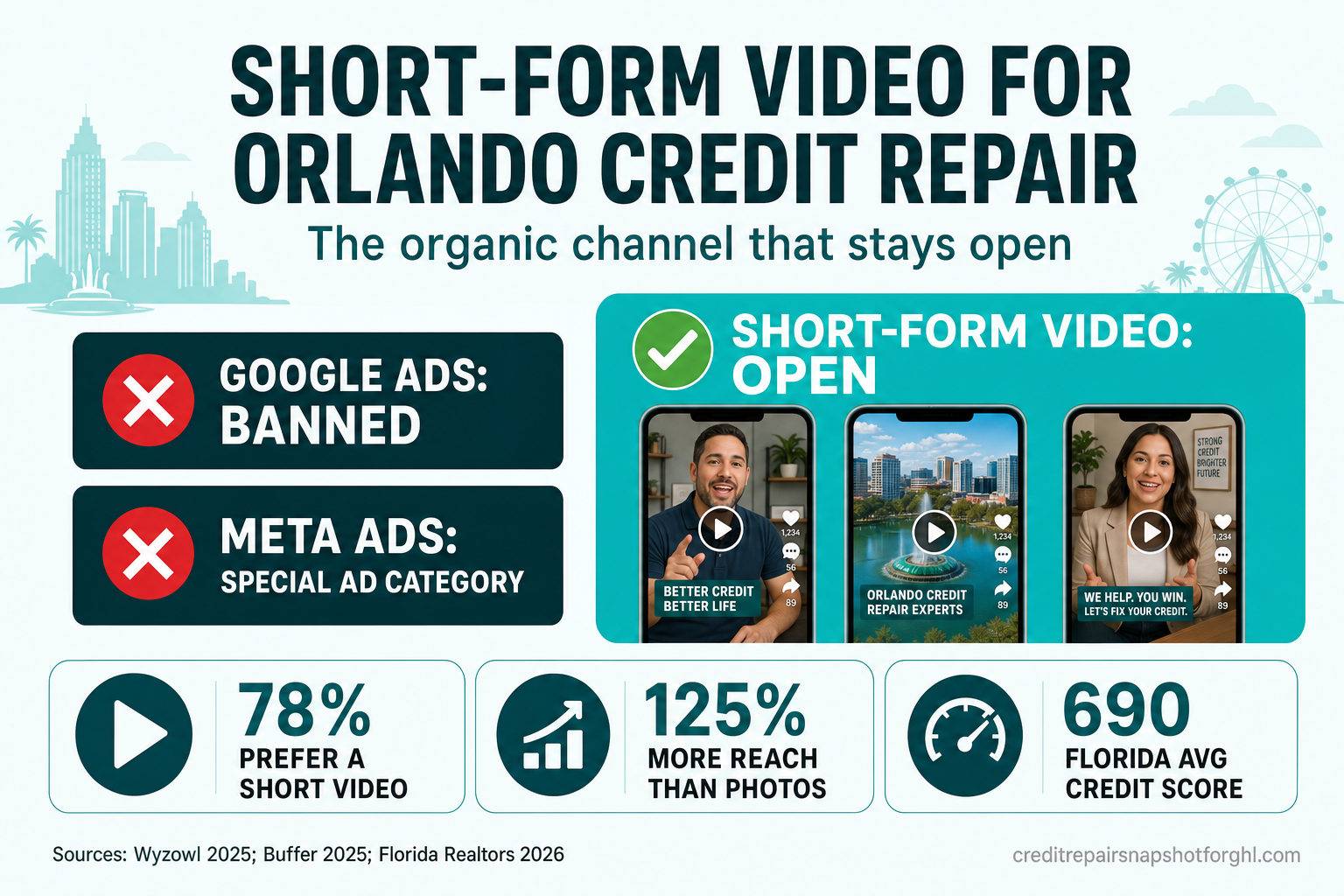
The reason this matters so much in this niche is structural, not stylistic. Google prohibits credit-repair advertising outright (Google Ads policy), and as of January 14, 2025 Meta requires credit and financial-services ads to run in a restricted “Financial Products and Services” Special Ad Category that strips out most of the targeting that makes paid social work (Meta Transparency Center). The paid front doors are bolted shut. Organic short-form video is the one that’s wide open — and it happens to be the format consumers most want to watch.
Table of contents
- The one-sentence answer
- Why short-form video is Orlando credit repair’s open lane
- What the data says about short-form video
- The short-form video lead engine (5 steps)
- What to actually film: 10 Orlando-ready video ideas
- Turning views into booked consults
- Staying CROA-compliant on camera
- Build it yourself or have it run for you
- Frequently asked questions
- About the author
- Sources
The one-sentence answer
Get credit repair clients with short-form video by publishing consistent, educational 30–60 second clips across Reels, TikTok, and Shorts, then routing every comment and DM into an automated flow that books the consultation — all while keeping the message on education and process, never promised outcomes. Everything below is how you do that without burning your week or crossing a compliance line.
Why short-form video is Orlando credit repair’s open lane
Most local businesses have a menu of acquisition channels: Google Search ads, Meta ads, local service ads, organic search, referrals, social. A credit-repair firm’s menu is shorter than almost anyone’s, because the two biggest paid channels are effectively off the table.
Google won’t sell you ads. Google’s financial-products policy prohibits ads for credit-repair services — for direct providers, lead generators, and referral services alike (Google Ads policy). When an Orlando consumer searches “fix my credit,” the sponsored slots other industries fight over simply aren’t available to you.
Meta will sell you ads, but with the brakes on. On January 14, 2025, Meta made the Financial Products and Services Special Ad Category mandatory for credit and financial ads targeting U.S. audiences. Ads in that category lose the levers that make paid social efficient: no gender targeting, an age range locked to 18–65+, no ZIP-code targeting (a minimum ~15-mile radius instead), no lookalike audiences, and most detailed interest and behavioral targeting grayed out (Meta Transparency Center; Data Axle, 2025). You can spend money; you mostly can’t aim it.
That leaves the channels you earn rather than rent: search, referrals, reviews, and organic social content. We’ve written the local-search side of that story in the San Diego Map Pack playbook, and the paid-social workarounds in the Facebook ads Special Ad Category guide. This post is about the highest-leverage earned channel of all right now: short-form video, the format that reaches strangers and warms them at the same time.
Every credit-repair firm I advise eventually realizes the same thing: you can’t buy your way in, so you have to be worth finding. Short-form video is the cheapest way to be findable and trustworthy at the same time — and unlike an ad, a good clip keeps working for months.
What the data says about short-form video
This isn’t a trend you’re early for — it’s a train that’s already left. Short-form video has been the highest-ROI content format for years running in HubSpot’s State of Marketing research, and it’s the format buyers actively prefer (HubSpot). When Wyzowl asked consumers how they’d most like to learn about a product or service, a short video won in a landslide over every other format.
The other half of the case is reach. On Instagram, Reels are the discovery format — they get pushed to people who don’t follow you, which is precisely the stranger a local firm needs to meet. Buffer’s 2025 analysis of hundreds of thousands of posts found Reels reached far more accounts than static formats.
Average share of an account’s audience reached, by Instagram format (%). Reels reach roughly 125% more people than photo posts and about 36% more than carousels. Source: Buffer, 2025 analysis.
Put the two together and the strategy writes itself: publish the format people most want to watch, on the surface that shows it to the most strangers, in the one channel your competitors can’t simply outbid you on.
And the demand is local and real. Florida’s average credit score sits around 690 — below the U.S. average near 715 — and edged lower through 2025 (Florida Realtors, 2026). Nationally, roughly 3 in 10 adults carry a subprime score under 670 (Experian, 2025), and the frustration behind those numbers is intense: credit and consumer reporting made up about 85% of all complaints the CFPB received in 2024 (CFPB). In a metro the size of Orlando, that’s a very large audience quietly searching for someone who explains this stuff clearly. Video is how you become that someone.
The short-form video lead engine (5 steps)
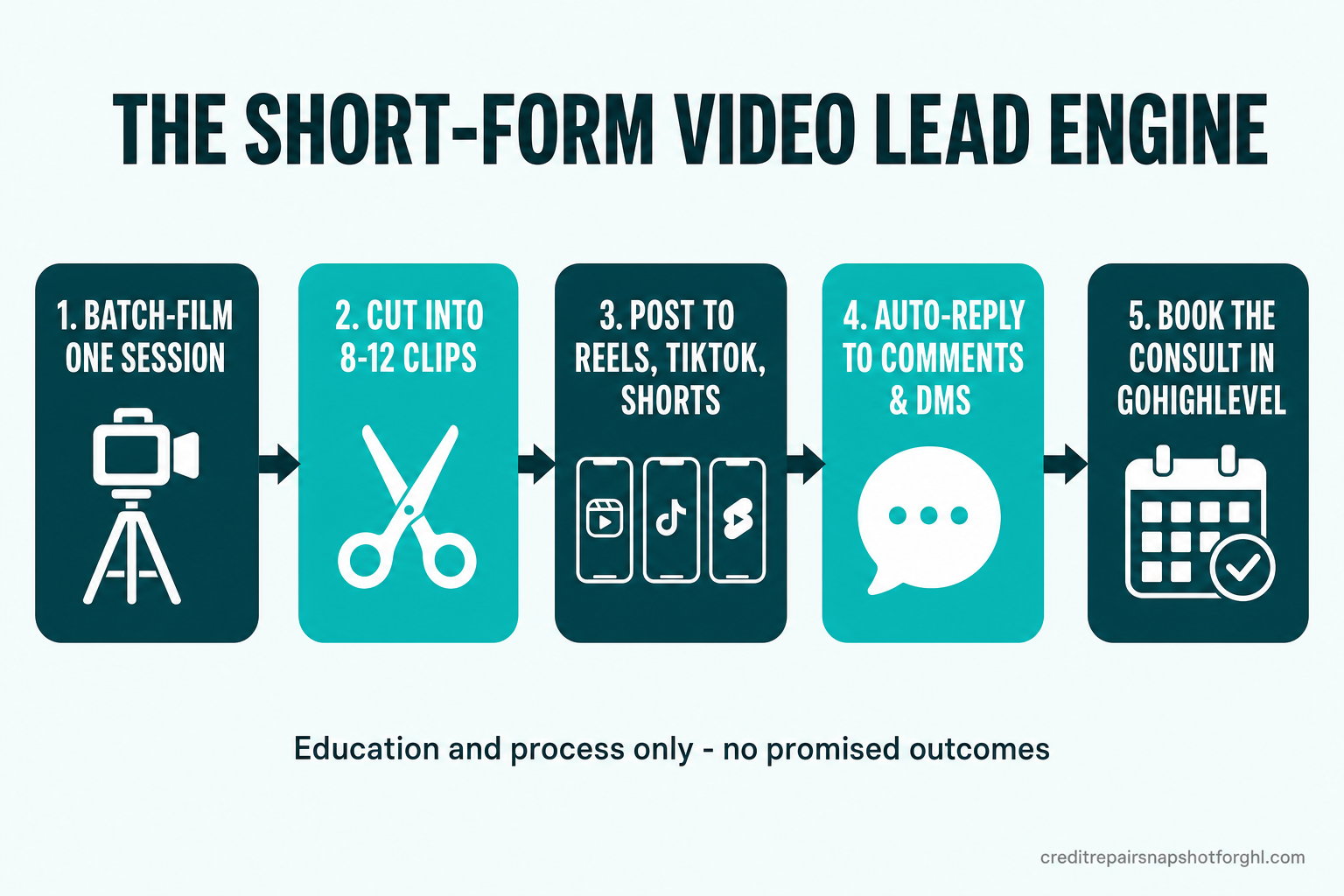
The mistake most firms make is treating video as “post when inspired.” That never survives a busy dispute week. The fix is to run it as a system: batch once, repurpose everywhere, automate the follow-up. Here is the whole engine.
Step 1 — Batch-film one session
Block 45 minutes, once a week or once every two weeks, and film a stack of clips back to back. A phone on a tripod, decent daylight or a $30 ring light, and a short list of questions is all you need. Batching is what makes this sustainable: you’re “on camera” for under an hour and you walk away with two weeks of content. Don’t chase production value — in short-form, a clear, human answer beats a polished ad every time.
Step 2 — Cut one session into 8–12 clips
Each answer becomes its own 30–60 second vertical clip. Add captions (most people watch on mute), a strong first line (“Denied for an apartment because of a collection you don’t recognize? Here’s what that means”), and a single idea per clip. One filming session should yield 8–12 posts — enough to cover the next couple of weeks across platforms.
Step 3 — Post across Reels, TikTok, and Shorts
The same vertical clip runs on Instagram Reels, TikTok, and YouTube Shorts with minimal changes. This is free distribution — three audiences, one edit. Consistency beats volume: three to five clips a week, every week, will out-perform a burst of twenty followed by silence. If keeping that cadence across platforms sounds like a part-time job, that’s exactly what a done-for-you social media system is for. For platform-specific tactics, our deep dives on Instagram, TikTok, and YouTube go further.
Step 4 — Auto-reply to comments and DMs
This is the step that turns views into leads, and the step most firms skip. When a clip lands, the comments fill with questions — and every question is a warm lead. An automation that watches for comment keywords, replies publicly, and slides the person a private message with a booking link captures that intent in seconds instead of whenever you next open the app. This is the same comment-and-DM automation that credit-repair firms use to convert Instagram and Facebook conversations, running on the Instagram DM automation and AI chatbot layer.
Step 5 — Book the consult in GoHighLevel
The DM’s job is one thing: get the person onto your calendar. A booking link drops them into self-scheduling, an instant confirmation goes out, and the lead lands in your CRM tagged by the video that brought them in — so you can see which clips actually produce consults. From there your normal intake takes over, including the CROA-compliant onboarding that every new client should run through.
What to actually film: 10 Orlando-ready video ideas
The best-performing credit-repair clips answer a real, specific question a nervous person is typing at 11 p.m. Educational, plain-spoken, and never a promise. Ten prompts to fill your first two batches:
- “What actually shows up on your credit report — and what doesn’t.”
- “The difference between a hard and soft inquiry, in 45 seconds.”
- “Got denied for an apartment in Orlando? Here’s how to read the reason.”
- “What a debt validation request is (and why it exists).”
- “Three myths about ‘boosting’ your score that waste people’s money.”
- “What the FTC found about credit report errors” — cite that 1 in 5 consumers had an error on a report (FTC).
- “How to pull all three of your reports for free.”
- “What to do the moment you spot an account that isn’t yours.”
- “Why we never promise to delete anything — and what we do instead.”
- “One question to ask any credit-repair company before you pay them.”
Notice what’s missing: no “we deleted 12 items in 30 days,” no before-and-after score screenshots, no guarantees. That restraint isn’t just compliance — it’s credibility. A skeptical Orlando buyer who’s been burned before trusts the firm that explains over the one that promises.
Turning views into booked consults
Views are vanity; booked consults pay the bills. The bridge between them is the follow-up system, and it maps directly onto the tools in a GoHighLevel snapshot:
- Comment automation watches for intent (“info,” “help,” a question) and replies, then opens a DM.
- DM automation and an AI chatbot answer the first question and drop a booking link — instantly, day or night, which matters because response speed is the single biggest driver of whether a lead ever books.
- Self-scheduling lets them grab a time without a phone call.
- Reminders get them to actually show up, the way our no-show playbook lays out.
- CRM tagging attributes each consult to the clip that created it, so you double down on what works.
That attribution loop is what separates a content habit from a content engine. When you know that your “hard vs. soft inquiry” clip books three consults a month, you make five more like it. This is the same demand-capture discipline behind our AI lead-generation playbook and the five-star review pipeline that turns those clients into the next wave of proof.
Staying CROA-compliant on camera
Short-form video puts your firm’s words in front of thousands of strangers, so the compliance bar is exactly the same as it is everywhere else — you’re just on camera now. The Credit Repair Organizations Act governs what you can say, and it doesn’t care whether you’re saying it in a contract or a Reel.
- Never promise an outcome. No “we’ll delete that in 30 days,” no guaranteed score jumps, no “we removed 15 items for this client.” Describe process and effort, not results.
- Educate, don’t advise. Explaining how a debt validation letter works is education. Telling a specific viewer what to do about their specific situation drifts toward advice — route that to a booked consult.
- Skip the score-screenshot flex. Before/after score images read as implied guarantees and age badly. Testimonials, if you use them, must be real and can’t imply a typical result.
- Keep captions and replies clean too. The comment your automation posts is a public statement from your firm. “Great, let’s get those removed!” is a compliance problem; “Happy to explain how our process works — sent you a link to book” is not.
Build it yourself or have it run for you
You can absolutely run this engine in-house. Buy a tripod, block a filming hour, learn a caption app, and build the comment-to-DM-to-booking flow in GoHighLevel yourself. Plenty of firms do, and if you have someone who enjoys being on camera and living in the content calendar, that’s a fine path — the DIY vs. done-for-you breakdown walks through the honest trade-offs.
The catch is consistency. Short-form video rewards the firm that posts every week for a year, and punishes the one that posts hard for a month and then gets swallowed by client work. That’s the real reason to consider a done-for-you social media system: not because you can’t film clips, but because the engine only pays off if it never stops — and the follow-up automation only captures leads if someone keeps it wired. If you’d rather hand the whole thing off, you can also hire a GoHighLevel VA to run the calendar and the DMs, or talk to us about a custom build on the Credit Repair Snapshot.
Whichever route you pick, the principle holds: in a niche where you can’t buy your way in, the firm that shows up consistently, explains clearly, and captures every raised hand wins. Short-form video is how you do all three at once.
Frequently asked questions
Why should an Orlando credit repair firm use short-form video instead of ads?
Because the ad channels are largely closed. Google prohibits credit-repair advertising outright, and since January 2025 Meta requires financial ads to run in a restricted Special Ad Category that removes gender targeting, ZIP-code targeting, lookalike audiences, and most detailed targeting. Organic short-form video on Reels, TikTok, and YouTube Shorts is one of the few scalable acquisition channels still fully open to the niche — and it's the format consumers most prefer to watch.
How often do I need to post to see results?
Consistency beats volume. Three to five short clips a week, every week, will out-perform an occasional burst. The practical way to hit that cadence is to batch-film once every week or two, cut each session into 8–12 clips, and post the same vertical video across all three platforms. A steady rhythm for a few months is what builds reach and trust.
Do I have to show my face on camera?
It helps, because trust in credit repair is personal, but it isn't mandatory. Faceless formats work too: screen-recorded explainers, text-on-screen tips over B-roll, whiteboard-style walkthroughs, or a team member who's comfortable presenting. The non-negotiable is clear, educational value in the first three seconds — not who's delivering it.
How does a video actually turn into a booked consultation?
Through the follow-up system, not the video itself. When a clip earns comments and DMs, an automation replies, opens a private message, and drops a self-scheduling link that books the consult straight into your CRM — tagged to the video that produced it. The content earns the attention; the automation captures it. A viral clip with no capture flow is a billboard with no phone number.
What can I say in a credit repair video without breaking CROA?
Educate about process; never promise outcomes. Explaining how credit reports, inquiries, or debt validation work is fine. Guaranteeing deletions, promising a specific score increase, or posting before/after score screenshots is not — those read as implied guarantees. Keep your captions and your automated replies just as clean as the video, and route anything that needs individual advice to a booked consultation with a human.
Is it worth paying someone to do this for me?
It depends on whether you'll keep it up. The engine only pays off if the posting never stops and the capture automation stays wired — and that's exactly where in-house efforts tend to break during a busy month. A done-for-you social media system films, edits, publishes, and maintains the booking flow so the channel keeps compounding whether or not you had time this week. If you'd rather keep it in-house, a GoHighLevel VA can run the day-to-day instead.
About the author
Marcus Pennington is a retention and recurring-revenue consultant who advises credit-repair business owners and the GoHighLevel agencies that serve them on the unglamorous side of growth — the systems that reliably turn attention into booked, paying, retained clients. A former SaaS churn analyst, he’s partial to attribution loops and allergic to hype, which is why he likes short-form video: it’s measurable, it compounds, and it can’t be bought. Marcus is a fictional editorial persona used for authorship attribution; this article is operational guidance, not legal or financial advice.
Related posts
- Facebook Ads for Credit Repair: the Special Ad Category playbook — how the paid channel is boxed in.
- DIY vs. Done-for-You Social Media for Credit Repair — the honest build-vs-buy trade-offs.
- Instagram & Facebook DM Automation for Credit Repair — the capture layer under the videos.
- Local SEO for Credit Repair: Winning the Map Pack — the other big earned channel.
- AI Lead Generation for Credit Repair — the full demand-capture system.
Sources
- Google Ads policy — prohibited financial products and services (credit repair) — support.google.com
- Meta Transparency Center — Financial and Insurance Products and Services (Special Ad Category) — transparency.meta.com
- Data Axle — 2025 Meta Special Ad Categories rules — data-axle.com
- Wyzowl — Short-Form Video Marketing (2025) — wyzowl.com
- HubSpot — Video Marketing Statistics (2025) — blog.hubspot.com
- Buffer — Instagram reach & engagement analysis (2025) — buffer.com
- Florida Realtors — Florida, U.S. credit scores continue to edge lower (2026) — floridarealtors.org
- Experian — What is the average credit score in the U.S.? (2025) — experian.com
- CFPB — 2024 Consumer Response Annual Report — consumerfinance.gov
- FTC — 2013 Credit Report Accuracy Study (1 in 5 had an error) — ftc.gov
- FTC — Credit Repair Organizations Act (CROA) — ftc.gov