
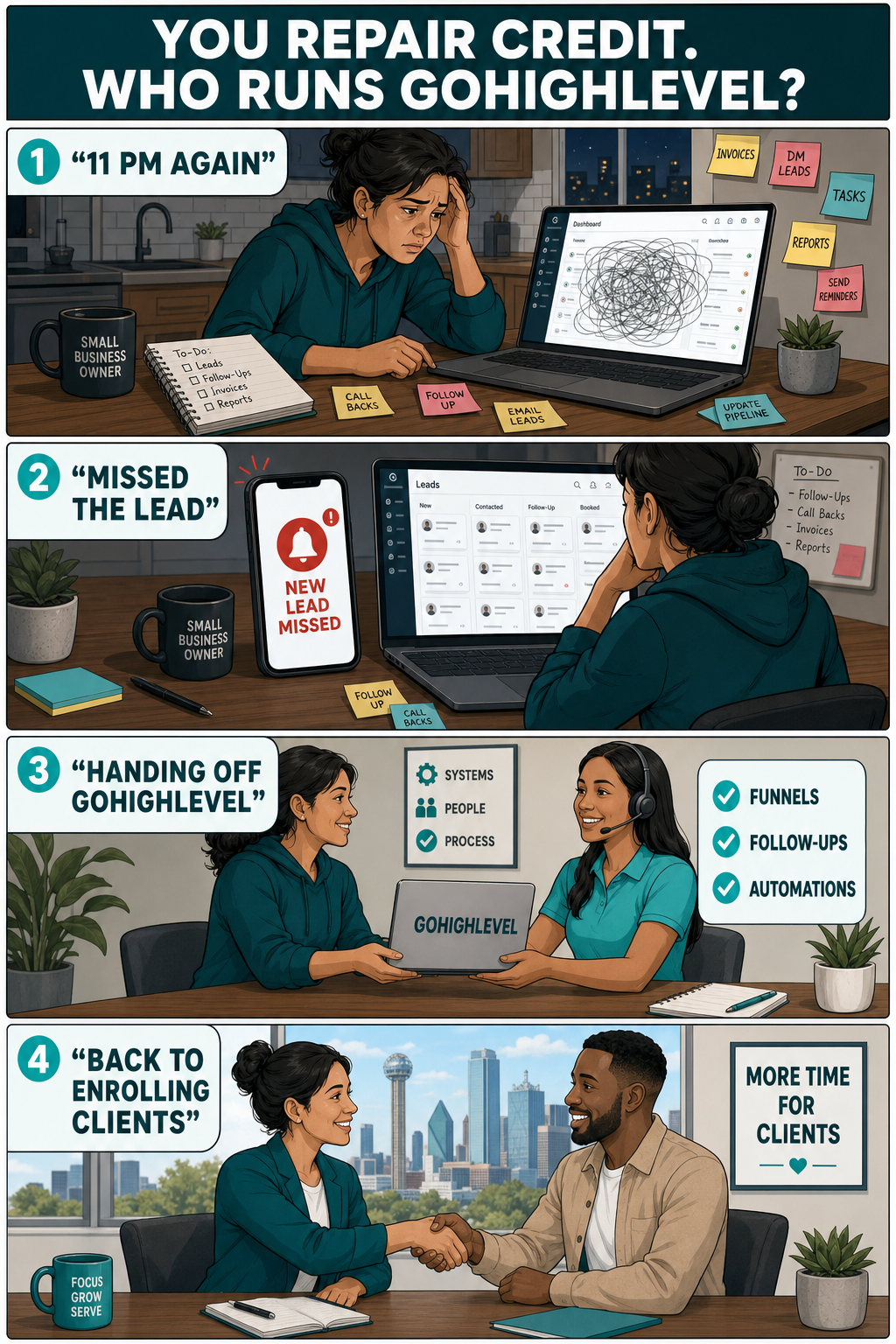
If you own a credit repair firm in Dallas, the most expensive employee in your business is probably you — sitting at the kitchen table at 11 p.m., watching a GoHighLevel tutorial, trying to figure out why the automation you built last week fired twice and tagged the wrong client. That hour isn’t free. It’s an hour you didn’t spend working a dispute round, calling a referral partner, or enrolling the lead who filled out your form at 9:47 p.m. and never heard back.
This is the quiet math almost no Dallas credit repair owner runs: the real cost of running GoHighLevel yourself isn’t the software subscription — it’s the revenue work you stop doing to become an unpaid CRM admin. This article puts a number on that cost, shows where the hours actually go, and lays out what a trained GoHighLevel virtual assistant (VA) takes off your plate — without ever touching the dispute strategy or compliance that has to stay with you.
Table of contents
- The real cost of running GoHighLevel yourself
- Where the solo owner’s week actually goes
- The hidden cost of inaction in Dallas
- What a GoHighLevel VA actually does for a credit repair firm
- DIY vs. hiring a GHL VA: an honest comparison
- Why this matters more in Dallas
- The compliance line a VA never crosses
- Frequently asked questions
- About the author
- Sources
The real cost of running GoHighLevel yourself
GoHighLevel is a powerful platform — it’s exactly where a credit repair firm’s onboarding, dispute rounds, billing, and retention should live. But “powerful” and “quick to run yourself” are not the same thing. GHL has workflows, triggers, pipelines, custom fields, snapshots, calendars, forms, and a dozen other surfaces, and every one of them is a place a busy owner can get stuck.
Here’s the trap. You didn’t get into credit repair to become a CRM administrator. You got in to fix credit files and enroll clients. Yet the moment you decide to run GHL yourself, you’ve quietly taken a second full-time job — one that pays nothing and competes directly with the work that does.
The cost shows up in three places:
- Opportunity cost. Every hour inside GHL — building a workflow, fixing a broken automation, formatting a dispute letter template — is an hour not spent on disputes, referral relationships, and enrollment calls. That’s the work that actually pays you.
- Speed cost. A CRM you’re too busy to maintain is a CRM that follows up slowly. Leads go cold, reminders don’t fire, and no-shows climb. (We break the booking side of this down in reduce no-shows for credit repair consultations.)
- Burnout cost. The nights-and-weekends grind is not sustainable, and it’s not free. It’s the reason owners plateau at a client count they can personally babysit — and never get past it.
Where the solo owner’s week actually goes
Start with how much time is on the table. Small business owners are chronically overworked, and the extra hours skew heavily toward administration, not the craft they went into business to do.
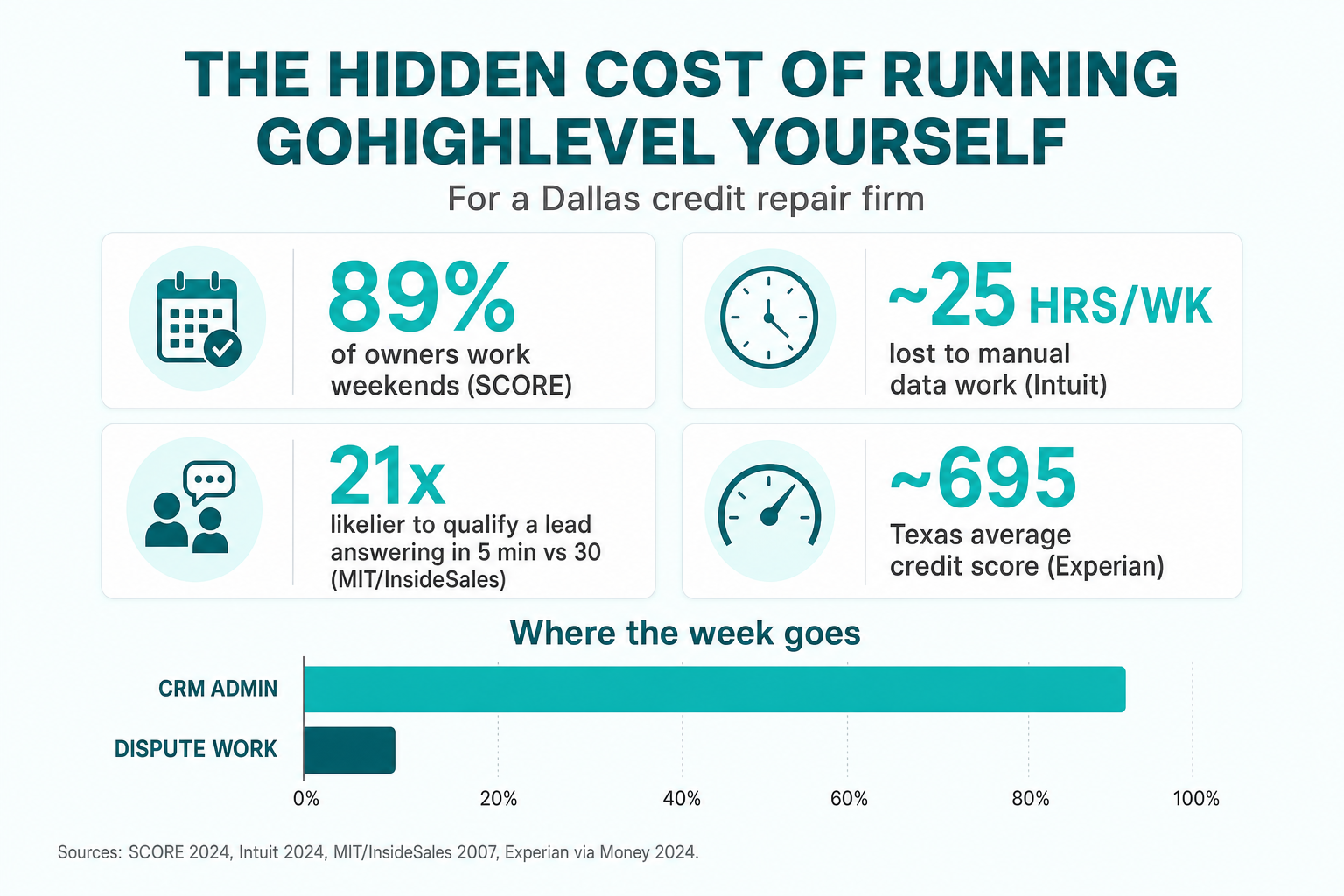
According to SCORE, the SBA’s mentoring partner, 33% of small business owners work more than 50 hours a week and 25% work more than 60, with 81% working nights and 89% working weekends (SCORE, 2024). Separately, The Alternative Board found 84% of business owners work more than 40 hours a week (The Alternative Board, 2024).
Where do those extra hours go? Overwhelmingly, into manual back-office work. Intuit’s 2024 research found small businesses lose about 25 hours a week to manual data entry and reconciling data across apps, and that manual data work had undermined productivity for 91% and profitability or growth for 85% of respondents (Intuit QuickBooks, 2024). For a credit repair firm, that “manual data work” has a specific face: re-typing client details into GHL, chasing documents, formatting letters, manually updating pipeline stages, and fixing automations that didn’t fire.
None of that is dispute work. None of it enrolls a client. It’s the operational overhead of running the machine — and it’s exactly the category a trained GoHighLevel VA is built to absorb.
The hidden cost of inaction in Dallas
The subtle cost of running GHL yourself isn’t just your time — it’s the leads you lose because a distracted owner can’t follow up fast enough. This is where the DIY approach quietly bleeds revenue.
Speed-to-lead is the most under-appreciated metric in this niche. The classic MIT/InsideSales Lead Response Management study — three years of data across 15,000+ leads — found that contacting a web lead within 5 minutes instead of 30 makes you about 21× more likely to qualify it, and 100× more likely to even reach the person (MIT/InsideSales, 2007). A newer Harvard Business Review audit of 2,241 companies found the average first-response time was 42 hours, and many firms never responded at all (HBR, 2011).
Now put that against the demand. Credit-repair demand is not a marketing invention — it’s structural. The FTC’s landmark accuracy study found 1 in 5 consumers had an error on at least one of their three credit reports (FTC, 2013). And in 2024 the CFPB received roughly 3.19 million complaints — about 85% of them about credit or consumer reporting (CFPB, 2024). A lot of that demand arrives after hours, from anxious people who just got denied and are searching on their phone.
In Dallas specifically, the pool is deep. The average credit score in Texas is about 695 — roughly 20 points below the U.S. average (Experian via Money, 2024), and Texas is home to about 3.3 million small businesses (SBA, 2024), many of them owner-operators who care intensely about their personal and business credit. The Federal Reserve Bank of Dallas even tracks Texas consumer-credit trends as a regional economic signal. The leads are there. The only question is whether your operation is fast and consistent enough to catch them — or whether you’re too busy inside GHL to answer.
What a GoHighLevel VA actually does for a credit repair firm
A GoHighLevel virtual assistant is not a generic “answer emails” VA. A trained, credit-repair-niche GHL VA is an operator who knows dispute-round logic, CROA guardrails, and how GHL’s pipelines and workflows actually behave — so they build and run your system correctly the first time, without the ramp-up.
Here’s the work a good GHL VA takes off an owner’s plate:
- Intake funnels and forms — building and maintaining the lead-capture funnels, landing pages, and intake forms that feed your pipeline.
- CROA-compliant onboarding flows — wiring up the signed-agreement, disclosure, and three-day-cancellation sequences so every client is onboarded cleanly. (See our CROA-compliant onboarding checklist.)
- Dispute-round workflows — the round-based automations that track progress and keep clients updated to the day, without you chasing them. (More in automate dispute rounds without losing compliance.)
- Speed-to-lead and follow-up — instant SMS/email responses, appointment reminders, and no-show recovery so leads get answered in minutes, not hours.
- Retention and billing automations — score-milestone messages, progress updates, dunning, and win-back flows that protect recurring revenue. (See our 7 retention automations.)
- AI setup — configuring the GoHighLevel AI Employee, AI chat widgets, and conversation flows to qualify and book while staying inside the rules.
- Reporting and cleanup — fixing broken automations, cleaning custom fields, and surfacing the workflow gaps you’d never have time to notice.
The owners who scale past a three-person plateau almost never do it by learning GoHighLevel faster. They do it by handing GHL to someone whose entire job is GHL — and buying back the twenty hours a week they were spending as an unpaid admin.
The point is division of labor. The VA runs the machine; you run the strategy. That’s the whole model behind our Hire a GHL VA service — a trained, credit-repair-niche GoHighLevel expert who builds your dispute flows, onboarding, automations, and AI, while you stay focused on fixing credit and enrolling clients.
DIY vs. hiring a GHL VA: an honest comparison
This isn’t “DIY is always wrong.” If you’re pre-revenue and have more time than money, learning GHL yourself is a legitimate stage. The comparison below is about what happens once you have clients and your time becomes the scarce resource.
| Factor | Running GoHighLevel yourself | A trained GHL VA |
|---|---|---|
| Who does the CRM work | You, at night and on weekends | A dedicated credit-repair GHL operator |
| Ramp-up | Weeks of tutorials; trial and error | None — they’ve built dispute flows before |
| Speed-to-lead | Slips when you’re busy with disputes | Automations maintained so leads get answered fast |
| Opportunity cost | High — your best hours leave dispute work | Low — you stay on strategy and enrollment |
| Cost | “Free,” paid in owner hours and burnout | A predictable monthly fee (plans from $700/mo) |
| Compliance | Yours to manage alone | VA builds inside CROA/TCPA guardrails; you own compliance |
| Scalability | Caps at what one owner can babysit | Scales up as volume grows, no lock-in |
For context on the “free” column: a full-time in-house administrative hire in the U.S. carries a median salary of about $47,460 a year before benefits and overhead (BLS, May 2024). A part-time, credit-repair-trained GHL VA starts at $700/month with no contract — a fraction of a full-time hire, and a fraction of the revenue you lose by doing it all yourself. (Figures are illustrative ranges; your numbers depend on volume and scope.)
Why this matters more in Dallas
Dallas is a dense, competitive market — a large metro inside the second-largest small-business state in the country (SBA, 2024). That cuts two ways for a credit repair firm.
On one hand, the demand is enormous: with the average Texas credit score sitting about 20 points under the national average (Experian via Money, 2024), there’s a deep, ongoing pool of people who need help understanding and improving their files — plus millions of Texas owner-operators who watch their personal and business credit closely.
On the other hand, that same density means competition. When a Dallas prospect searches “credit repair near me” at 10 p.m., several firms will surface. The one that answers in minutes — with a clean, automated intake and a real booking path — wins the consult. The one whose owner is buried in a GHL workflow and replies at noon the next day loses it. In a market this size, the difference between a five-minute response and a next-day response isn’t a small edge; it’s the whole game, repeated hundreds of times a year.
A GHL VA is how a small Dallas firm punches above its weight: your operation runs like a firm three times your size, because someone is keeping the machine tuned while you do the work only you can do.
The compliance line a VA never crosses
Here’s the guardrail that makes this model safe for credit repair specifically. A GoHighLevel VA runs your operations — the funnels, the workflows, the follow-up, the automations. A VA does not run your compliance or your dispute strategy, and a good one never pretends to.
That means:
- Every automated message describes process and effort — never a promised outcome. No “we’ll delete this” and no “your score will jump.” That’s CROA, and it’s non-negotiable.
- The firm remains the credit repair organization. You own the signed agreements, the disclosures, the three-day cancellation right, and the dispute decisions. The VA wires the workflow that delivers those; you own what they say.
- TCPA consent is built into the automations, not bolted on. A trained VA sets up consent capture and messaging cadence correctly — because in this niche, a sloppy automation isn’t just ineffective, it’s a liability.
The result is the split every scaling firm eventually finds: you keep the strategy, the client relationship, and full control of compliance — and you hand the CRM to someone whose entire job is the CRM. That’s how you get your nights back without giving up an ounce of control over the part that matters.
Frequently asked questions
What does a GoHighLevel VA do for a credit repair firm?
A trained GoHighLevel VA builds and runs the operational layer of your firm inside GHL: intake funnels and forms, CROA-compliant onboarding sequences, dispute-round workflows, speed-to-lead follow-up, appointment reminders and no-show recovery, retention and billing automations, and AI chat or receptionist setup. They handle the CRM administration so the owner can focus on dispute strategy and enrolling clients. The VA runs operations, not compliance — the firm remains the credit repair organization responsible for CROA.
How much does it cost to hire a GoHighLevel VA versus running GHL myself?
Running GHL yourself feels free but is paid in owner hours and lost revenue — small business owners already work heavy nights and weekends (SCORE, 2024), and much of that time is manual CRM admin. A part-time, credit-repair-trained GHL VA starts around $700/month with no contract, compared with a full-time in-house administrative hire at a median of about $47,460/year before benefits (BLS, May 2024). For most firms with clients, the VA is far cheaper than the opportunity cost of the owner doing it all.
Is a GoHighLevel VA worth it for a small Dallas credit repair firm?
For a firm that already has clients, usually yes. Dallas sits in the second-largest small-business state (SBA, 2024) with an average Texas credit score about 20 points below the national average (Experian via Money, 2024) — strong, ongoing demand. The bottleneck is rarely leads; it's an owner too busy inside GHL to answer them fast. Since responding in 5 minutes vs. 30 makes you roughly 21x more likely to qualify a lead (MIT/InsideSales, 2007), a VA who keeps your follow-up automations running directly protects revenue.
Will a GoHighLevel VA handle my credit disputes or compliance?
No — and that's by design. A GHL VA builds and runs the workflows that deliver your process: onboarding, client-update automations, progress tracking, follow-up, and billing. The dispute strategy, the decisions, and CROA/TCPA compliance stay with you, the credit repair organization. Every automated message the VA builds describes process and effort, never a promised deletion or score increase. The VA makes your compliant system run reliably; it never changes what you're allowed to claim.
How fast can a GoHighLevel VA get started?
With a credit-repair-niche GHL VA who has built dispute workflows and CROA onboarding flows before, there's essentially no ramp-up — they hit the ground running. Our Hire a VA engagements typically start in about 5 days, are 100% white-label, include a project manager, and deliver every task with a screen-recorded Loom walkthrough so you can see exactly what was built. There's no long-term contract, so you can scale hours up or down as your pipeline grows.
Can a GoHighLevel VA set up AI answering and chat for my firm?
Yes. A trained GHL VA configures the GoHighLevel AI Employee, AI chat widgets, and conversation flows to answer inbound inquiries, qualify leads, and book consultations 24/7 — including the after-hours traffic that's common in credit repair. The AI is deployed inside compliance guardrails: it describes process, captures consent, and never gives credit, legal, or financial advice or promises a result. It answers and books; your specialists keep the strategy and the relationship.
About the author
Marcus Pennington is a Retention & Recurring-Revenue Consultant based in Dallas, TX, who advises credit repair business owners and the GoHighLevel agencies that serve them on the unglamorous side of growth: keeping the operation running so the owner can stay on the revenue work. A former SaaS churn analyst, he reverse-engineers where firms leak time and money — slow follow-up, manual admin, and owner burnout — and designs the systems that plug those leaks without ever overpromising a result. Marcus is a fictional editorial persona used for authorship attribution; his articles are operational guidance, not legal or financial advice.
Related reading
- GoHighLevel AI Employee for Credit Repair: A Compliance-First Deployment Guide
- Automate Dispute Rounds Without Losing Compliance
- 7 Retention Automations That Keep Credit Repair Clients Paying
- Reduce No-Shows for Credit Repair Consultations
- Credit Repair Industry Statistics 2026: Market Size, Demand & Benchmarks
Sources
- SCORE — Small Business Owners Work Long Hours (2024) — 33% work 50+ hrs/wk, 25% work 60+, 81% work nights, 89% work weekends.
- The Alternative Board — 84% of Entrepreneurs Are Working Overtime (2024) — 84% of owners work more than 40 hours a week.
- Intuit QuickBooks — Business Solutions Report (2024) — ~25 hrs/week lost to manual data work; 91% say it hurt productivity, 85% profitability/growth.
- MIT / InsideSales.com — Lead Response Management Study (2007) — 5 min vs 30 min = ~21× more likely to qualify, ~100× more likely to reach.
- Harvard Business Review — The Short Life of Online Sales Leads (2011) — average first response 42 hours; many never respond.
- FTC — Study of Credit Report Accuracy (2013) — 1 in 5 consumers had a credit-report error.
- CFPB — 2024 Consumer Response Annual Report — ~3.19M complaints; ~85% about credit/consumer reporting.
- Money — Average Credit Score by State (Experian data, 2024) — Texas average ~695, ~20 points below the U.S. average.
- SBA Office of Advocacy — Texas 2024 Small Business Profile — ~3.3 million small businesses in Texas.
- Federal Reserve Bank of Dallas — Texas Consumer Credit Trends — regional consumer-credit tracking.
- U.S. Bureau of Labor Statistics — Secretaries & Administrative Assistants (OES, May 2024) — median wage ~$47,460/year.
Credit Repair Snapshot for GHL is a GoHighLevel automation product and service provider. We are not a credit repair organization, law firm, or credit bureau, and we do not dispute items, repair credit, or provide credit, legal, or financial advice. You remain responsible for CROA and TCPA compliance. Results vary; we make no promise that any item will be removed or that any score will improve.