

For a Miami credit repair firm, the fastest way to lose a prospect isn’t a weak offer or a high price — it’s a website that takes four seconds to appear on their phone. By then they’ve already tapped back to Google and called the next firm in the map pack. When you can’t run Google Ads for credit repair, every organic and referral visitor is expensive to earn and easy to waste, and page speed is the setting that quietly decides how many of them convert.
This is a practical comparison of the two ways most credit repair firms put a marketing site online — a page-builder site (GoHighLevel or WordPress) versus a purpose-built Astro site — measured on the thing that actually moves bookings: real-world load time and Google’s Core Web Vitals. We sell the operating system, never the outcome: nothing here promises a score change, and neither should your website.
Table of contents
- Why page speed decides Miami credit repair bookings
- What the data says about speed and conversions
- Core Web Vitals in 2026: the scoreboard Google actually uses
- Astro vs GoHighLevel vs WordPress: the architecture difference
- Side-by-side comparison for a credit repair marketing site
- Where GoHighLevel still wins (and should keep winning)
- What a fast credit repair site needs in Miami
- Frequently asked questions
- About the author
- Sources
Why page speed decides Miami credit repair bookings
Start with the searcher. Someone in Miami just got denied on an auto loan or a mortgage pre-approval and pulls out their phone to search “credit repair near me.” They’re anxious, skeptical — this niche is shadowed by scammy operators — and they will judge your trustworthiness in the first two seconds, largely on how quickly and cleanly your site loads.
Two structural facts make speed non-negotiable for this niche specifically:
- You can’t buy your way back in. Google’s advertising policy bans credit repair ads from serving at all, so you can’t offset a leaky website with paid traffic. Every visitor arrives through organic search, the map pack, referrals, or social — channels you worked to earn. Losing them to load time is pure waste. (For the full picture of why organic is the primary channel here, see our credit repair SEO playbook.)
- The audience is overwhelmingly mobile. Mobile is about 54% of US web traffic and rising (StatCounter, 2026), and for a local, emotionally-driven “near me” search the mobile share is higher still. Mobile is exactly where heavy, plugin-laden sites struggle most — on a phone, on a cellular connection, in a Miami parking lot.
The demand is real and large. In 2024 the CFPB logged more than 2.8 million consumer complaints, and about 85% of them were about credit or consumer reporting (CFPB, 2024). The FTC’s landmark study found 1 in 5 consumers had an error on at least one credit report (FTC, 2013). People are actively looking for help — the only question is whether your site is fast enough to be the one they choose. For the full market picture, see our 2026 credit repair industry statistics.
What the data says about speed and conversions
Speed isn’t a preference; it’s measurable money. The relationship between load time and abandonment is steep and well-documented.
Google’s mobile benchmark research trained a model on real page-load data and found that as load time climbs, the probability of a bounce climbs with it — sharply.
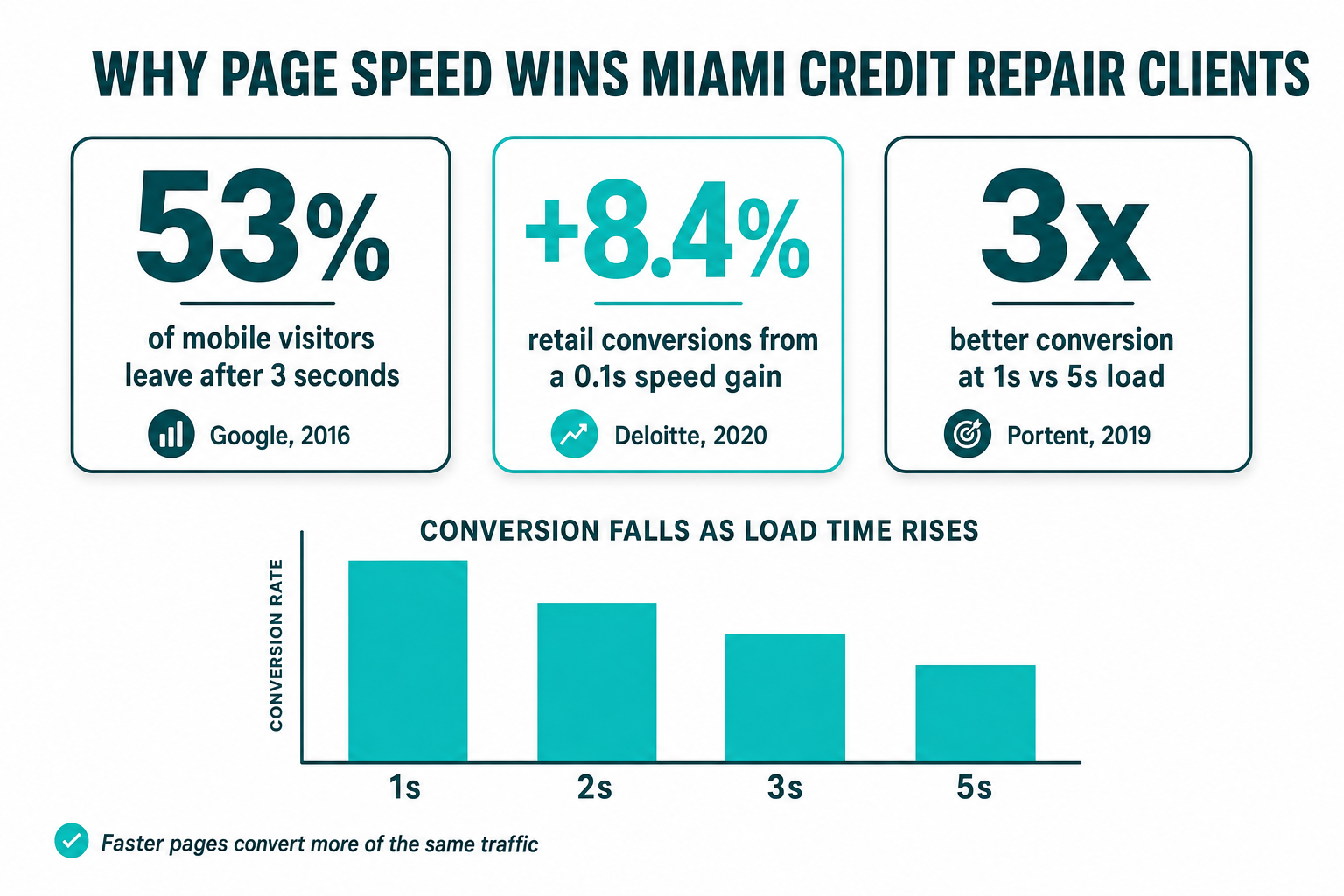
Put plainly: 53% of mobile site visits are abandoned if a page takes longer than 3 seconds to load (Google, 2016). Half your hard-won traffic can vanish before your headline renders.
The flip side is just as measurable — small speed gains lift conversions. Google and Deloitte’s Milliseconds Make Millions study found that a mere 0.1-second improvement in mobile site speed moved real business metrics across verticals.
Independent data agrees. Portent’s analysis of tens of millions of pageviews found a site that loads in 1 second converts about 3× better than one loading in 5 seconds, with conversion rates falling roughly 4.42% for each additional second between 0 and 5 seconds (Portent, 2019). For a credit repair firm running on earned, un-buyable traffic, that multiple is the difference between a booked consult and a bounce.
Core Web Vitals in 2026: the scoreboard Google actually uses
“Fast enough” has an objective definition now. Core Web Vitals are three real-user metrics Google publishes thresholds for, and page experience — including Core Web Vitals — is a confirmed Google ranking signal. To be rated “good,” a site needs to hit all three at the 75th percentile of real visits:
- Largest Contentful Paint (LCP) ≤ 2.5 seconds — how fast the main content appears (web.dev).
- Interaction to Next Paint (INP) ≤ 200 milliseconds — how responsive the page feels when tapped. INP officially replaced First Input Delay on March 12, 2024 (web.dev).
- Cumulative Layout Shift (CLS) ≤ 0.1 — how visually stable the page is as it loads (web.dev).
Here’s why the platform choice matters: heavy JavaScript is the single biggest enemy of INP and LCP. Every page-builder script the browser has to download, parse, and execute pushes those numbers up. The question isn’t whether GoHighLevel or WordPress can be tuned to pass — it’s what they ship by default, on a real Miami phone, before anyone optimizes anything.
Astro vs GoHighLevel vs WordPress: the architecture difference
The three approaches differ in one architectural decision that drives everything else: how much JavaScript reaches the browser.
- GoHighLevel sites are built in a drag-and-drop funnel/site builder. That’s wonderful for non-technical editing, but the trade-off is a page loaded with builder runtime, tracking, chat widgets, and embedded scripts — even on a simple “About” page. GHL is a CRM-and-marketing platform first; the website builder is a convenience layer on top of it.
- WordPress sites typically stack a theme, a page builder (Elementor, Divi), and a dozen plugins, each adding CSS and JavaScript. It’s flexible, but the median WordPress page carries real weight. Across the whole web, only about 44% of sites pass Core Web Vitals on mobile (HTTP Archive Web Almanac, 2024) — and plugin-heavy builders sit on the wrong side of that line more often than not.
- Astro sites invert the model. Astro ships zero JavaScript by default and renders static HTML at build time, sending only the tiny bit of interactivity a page actually needs (“islands”). In Astro’s own framework study — built on Chrome UX Report and HTTP Archive data — Astro was the only framework where more than 50% of real-world sites passed Google’s Core Web Vitals assessment, against a 40.5% average across all frameworks (Astro, 2023).
The mistake I see Miami firms make is treating “where the CRM lives” and “where the marketing site lives” as the same decision. They aren’t. Run your disputes and billing in GoHighLevel. Serve your public pages from a static-first stack that loads before the prospect loses patience.
That’s the honest framing: this isn’t Astro beating GoHighLevel — it’s using each for what it does best. For the automation side of that split, our Snapshot automation system and prebuilt website feature are designed to hand the marketing front-end the speed it needs while GHL runs the operations behind it.
Side-by-side comparison for a credit repair marketing site
Here’s how the two approaches stack up on the factors that actually decide bookings and rankings for a local credit repair firm. (PageSpeed figures for the Astro column reflect the Get a Website build standard; page-builder ranges reflect typical plugin-laden builds and vary by configuration.)
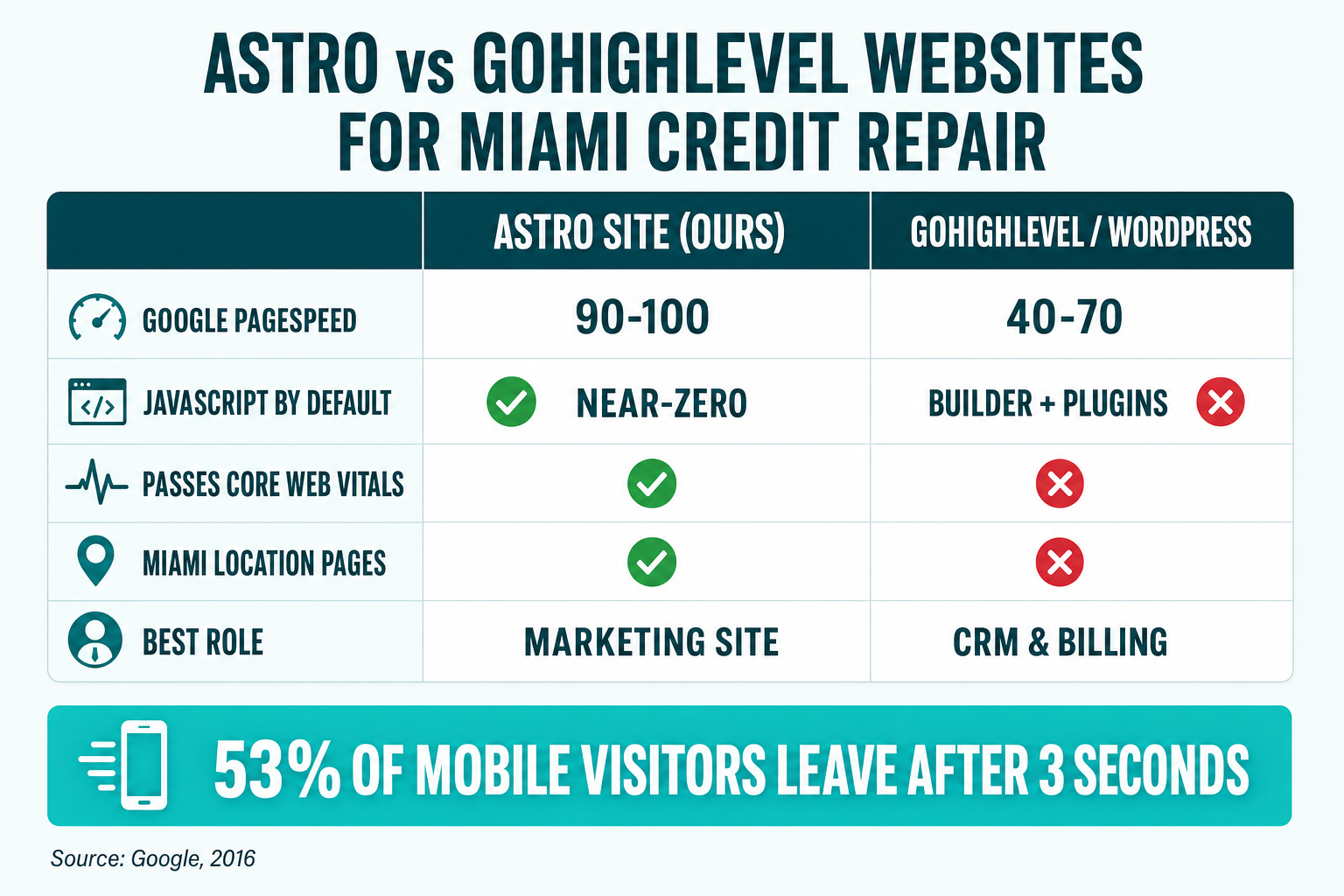
| Factor | Astro build (ours) | GoHighLevel / WordPress site |
|---|---|---|
| Google PageSpeed target | 90–100, static-first | Commonly 40–70 on mobile with builder/plugin load |
| JavaScript shipped by default | Near-zero (“islands” only) | Builder runtime + plugins/widgets on every page |
| Core Web Vitals pass rate | Framework built to pass all three | Often fails INP/LCP without heavy tuning |
| Local/location pages | Individually optimized per Miami-area city | Templated; often thin or missing |
Editable meta, schema & llms.txt |
Full control, built-in | Limited; schema and llms.txt often manual or absent |
| Best role | Public marketing website | CRM, disputes, billing, automation |
| Trust impression | Fast, modern, credibility-building | Depends heavily on template and load speed |
The point of the table isn’t that GoHighLevel is “bad.” It’s that a public-facing credit repair marketing site — the page a nervous Miami prospect judges you by — has different requirements than a CRM, and a static-first build meets them more reliably.
Where GoHighLevel still wins (and should keep winning)
Speed is a marketing-site metric. It says nothing about the parts of your business GoHighLevel runs brilliantly — and you should not move those. GHL is the right home for:
- CROA-compliant onboarding — signed agreements, the Consumer Credit File Rights disclosure, and the three-day cancellation right, captured with an audit trail.
- Dispute-round operations — report-change monitoring, client progress tracking, and status updates that run to the day.
- Recurring billing and dunning — monthly billing on autopilot with payment recovery that protects MRR.
- Speed-to-lead and retention — instant follow-up on every inbound lead (the mechanics are in our AI lead generation playbook) and the five-star review pipeline that turns happy clients into referrals.
The winning architecture for a Miami firm is a fast Astro marketing site out front — capturing and converting the search and referral traffic — feeding leads into GoHighLevel, where the disputes, billing, and retention actually happen. You get the speed where it converts and the automation where it operates.
What a fast credit repair site needs in Miami
If you’re evaluating or rebuilding your site, judge it against this checklist — it’s what separates a site that ranks and books from one that just exists:
- Sub-2-second mobile load and green Core Web Vitals. Test your current site on PageSpeed Insights right now. If mobile is below 70 or any Core Web Vital is red, you’re leaking bookings.
- Real Miami-area location pages. Individually optimized pages for the neighborhoods and nearby cities you serve — the highest-leverage way local firms win the map pack and organic results.
- Clean schema, canonical tags, and an
llms.txt. So both Google and AI answer engines (AI Overviews, ChatGPT, Perplexity) can read and cite you — increasingly how prospects discover a “credit repair near me” answer. - A trustworthy, modern design. In a niche crowded with scam operators, a clean, fast site is itself a trust signal that earns the consult.
- A booking path and AI chat widget that turns the fast visit into a scheduled call without giving credit or legal advice.
You can build this yourself, or you can get a website built on exactly this stack — a guaranteed 90+ PageSpeed Astro site with location pages, schema, an AI chat widget, review automation, and managed hosting for $497 one-time plus $97/month. Pair it with the Credit Repair Snapshot so the leads it captures flow straight into your onboarding, progress-tracking, and billing workflows. Either way, the standard is the same: load fast, rank locally, and make a cautious Miami prospect feel safe enough to book.
Frequently asked questions
Is an Astro website actually faster than a GoHighLevel or WordPress site?
In general, yes — because of architecture, not marketing. Astro ships zero JavaScript by default and renders static HTML at build time, while GoHighLevel and WordPress load builder runtime, plugins, and widgets on every page. In Astro's 2023 framework study (built on Chrome UX Report and HTTP Archive data), Astro was the only framework where over 50% of real-world sites passed Google's Core Web Vitals, against a 40.5% all-framework average. Any platform can be tuned, but a static-first build starts far ahead.
Should I move my whole business off GoHighLevel to Astro?
No. Keep GoHighLevel for what it does best — CRM, CROA-compliant onboarding, dispute-round progress tracking, recurring billing, and retention. The recommendation is narrower: put your public marketing website on a fast, static-first stack, and feed the leads it captures into GoHighLevel. Use each tool for its strength.
How much does website speed really affect credit repair bookings?
Substantially, because credit repair traffic is earned rather than bought. Google found 53% of mobile visits are abandoned when a page takes over 3 seconds to load, and the probability of a bounce rises 90% as load time goes from 1 to 5 seconds. Portent found a 1-second site converts roughly 3x better than a 5-second one. Since you can't run Google Ads for credit repair, every visitor is expensive to lose to load time.
What are Core Web Vitals and do they affect my Google ranking?
Core Web Vitals are three real-user metrics Google uses to grade page experience: Largest Contentful Paint (≤2.5s), Interaction to Next Paint (≤200ms, which replaced First Input Delay in March 2024), and Cumulative Layout Shift (≤0.1). Page experience, including Core Web Vitals, is a confirmed Google ranking signal — so a faster site both ranks and converts better.
Why do location pages matter for a Miami credit repair firm?
Because most credit-help searches are local and mobile — people add a city or 'near me' even for virtual services, and 98% of consumers use the internet to find local businesses. Individually optimized pages for the Miami-area cities and neighborhoods you serve are the single highest-leverage way local firms win the map pack and organic results, versus one generic templated page.
Does a fast website mean I can promise faster credit results?
No. A fast, well-structured website improves how many searchers find you and book — it says nothing about credit outcomes. Your marketing must describe process and effort, never promise a deletion or score increase, and your firm remains the credit repair organization responsible for CROA compliance. Speed helps you reach the right people; it never changes what you're allowed to claim.
About the author
Simone Braxton is a GHL Automation Strategist focused on credit repair operations. She spent eight years running back-office operations for credit-repair firms before moving full-time into GoHighLevel implementation, and she writes about the systems — from compliant automation to the marketing front-end — that decide whether a firm scales or stalls. Simone is a fictional editorial persona used for authorship attribution; her articles are operational guidance, not legal or financial advice.
Related reading
- Credit Repair SEO: The 2026 Local + Organic Search Playbook
- Credit Repair Industry Statistics 2026: Market Size, Demand & Benchmarks
- AI Lead Generation for Credit Repair: The 2026 Playbook
- The five-star review pipeline for credit-repair firms
Sources
- Think with Google — New Industry Benchmarks for Mobile Page Speed (2017) — bounce probability rises 32% (1s→3s), 90% (1s→5s), 106% (1s→6s), 123% (1s→10s).
- Think with Google / DoubleClick — The Need for Mobile Speed (2016) — 53% of mobile visits abandoned if load > 3s.
- web.dev — Milliseconds Make Millions (Deloitte + Google, 2020) — 0.1s speed gain: retail conv. +8.4%, AOV +9.2%; travel conv. +10.1%, AOV +1.9%.
- Portent — Site Speed Is (Still) Impacting Your Conversion Rate (2019) — 1s site ≈ 3× conversion of 5s; ~4.42% drop per added second (0–5s).
- web.dev — Largest Contentful Paint, Interaction to Next Paint, Cumulative Layout Shift — CWV “good” thresholds.
- web.dev — INP becomes a Core Web Vital (Mar 12, 2024) — INP replaced FID.
- Google Search Central — Page Experience — Core Web Vitals is a ranking signal.
- Astro — 2023 Web Framework Performance Report — Astro only framework > 50% passing CWV; 40.5% all-framework average.
- HTTP Archive Web Almanac 2024 — Performance — ~44% of sites pass Core Web Vitals on mobile.
- StatCounter — Platform Market Share, United States (2026) — mobile ≈ 54% of US web traffic.
- CFPB — 2024 Consumer Response Annual Report — 2.8M+ complaints; ~85% credit/consumer reporting.
- FTC — Study of Credit Report Accuracy (2013) — 1 in 5 consumers had a credit report error.
- BrightLocal — Local Consumer Review Survey — 98% use the internet to find local businesses.
Credit Repair Snapshot for GHL is a GoHighLevel automation product. We are not a credit repair organization, law firm, or credit bureau, and we do not dispute items, repair credit, or provide credit, legal, or financial advice. You remain responsible for CROA and TCPA compliance. Results vary; we make no promise that any item will be removed or that any score will improve.