
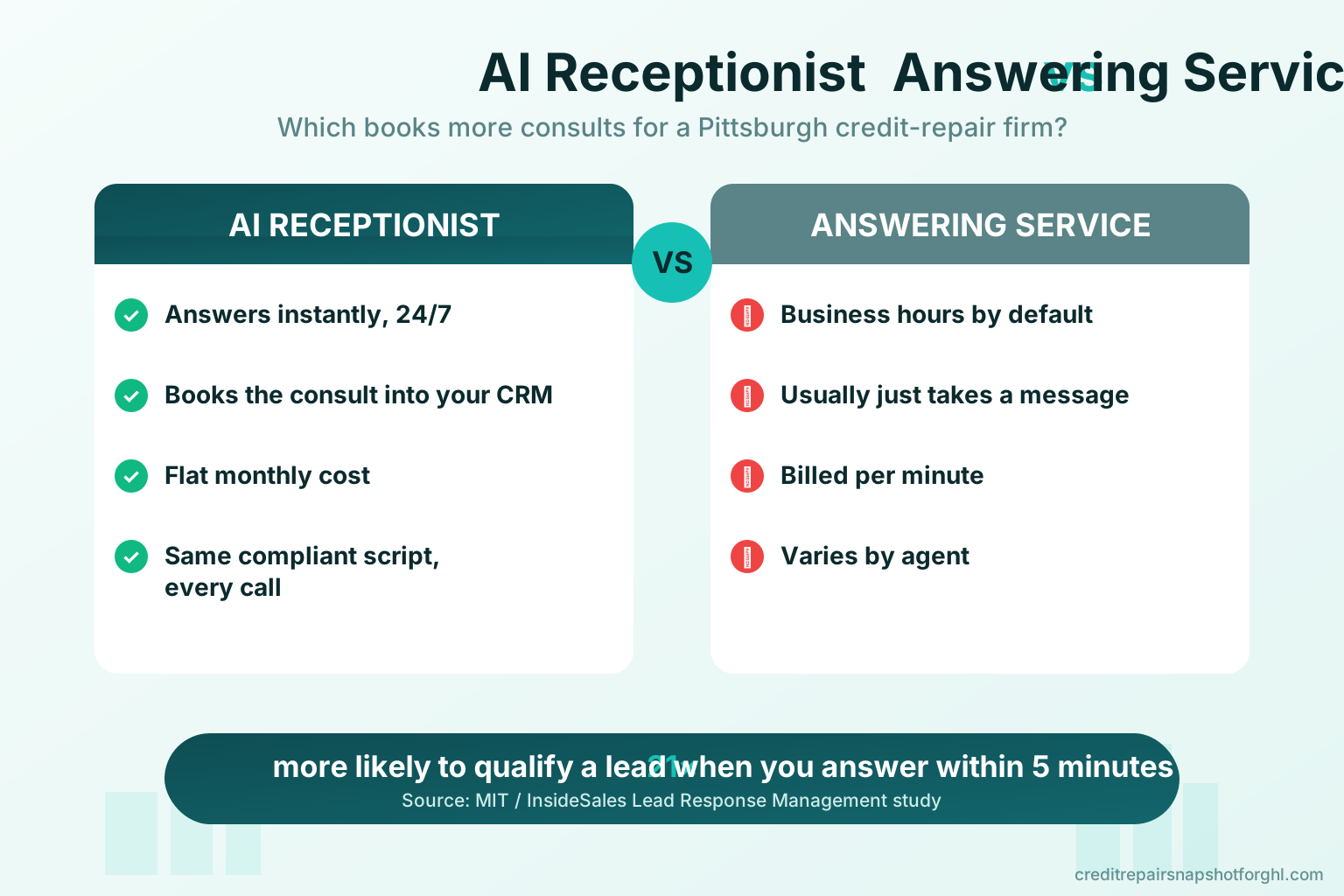
For a Pittsburgh credit-repair firm, the question isn’t really “AI receptionist or answering service?” — it’s “what happens to the person who calls at 8:47 p.m. after seeing a collection notice?” If that call goes to voicemail, most callers hang up and dial the next firm. The short answer: an AI receptionist wins for most credit-repair firms because it answers instantly, 24/7, books the consult straight into your CRM, and costs a flat monthly fee instead of per-minute billing — while a human answering service mostly takes a message and hands it back to you to chase. Both have a place; this comparison shows exactly where each one fits.
We sell the operating system, never the outcome. Nothing here — and nothing your receptionist or answering service says — should ever promise a score increase or a deletion. Both tools are intake and scheduling layers; your firm stays the credit-repair organization responsible for compliance.
Table of contents
- The one-line answer
- Why Pittsburgh credit-repair firms live or die by the phone
- What the data says about slow and missed calls
- How each option actually works
- Head-to-head: AI receptionist vs answering service
- The real cost, month over month
- The compliance line neither can cross
- So which should a Pittsburgh firm choose?
- How to deploy a CROA-safe AI receptionist
- Frequently asked questions
- About the author
- Sources
The one-line answer
For most Pittsburgh credit-repair firms, an AI receptionist is the better first hire because it answers every call in one ring, qualifies the caller against your intake script, and books the consultation directly into GoHighLevel — at a predictable flat cost, around the clock, in English or Spanish. A human answering service is the right call when you specifically want a live person’s warmth on every call, have low, predictable volume, and are comfortable that most contacts arrive as messages you’ll follow up on yourself. Everything below is how to tell which describes you.
Why Pittsburgh credit-repair firms live or die by the phone
Most local businesses have a full menu of ways to buy attention. A credit-repair firm has one of the shortest menus in any industry, because the two biggest paid channels are effectively closed.
Google won’t sell you search ads. Google’s financial-products policy prohibits ads for credit-repair services outright — for direct providers, lead generators, and referral services alike (Google Ads policy). And since January 14, 2025, Meta requires credit and financial-services ads to run inside a restricted “Financial Products and Services” Special Ad Category that strips out ZIP-code targeting, lookalikes, and most detailed targeting (Meta Transparency Center). (We break the paid picture down in why Google Ads are banned for credit repair.)
The practical consequence for a firm in Pittsburgh: almost every lead you get is earned — through referrals, local SEO, and organic content — which makes each one expensive and each dropped call a real loss. When a prospect in Allegheny County finally works up the nerve to call about their credit, that call is the payoff for weeks of marketing. Sending it to voicemail is like paying for a lead and then throwing it in the trash.
What the data says about slow and missed calls
The case for answering fast isn’t a matter of taste — it’s one of the most replicated findings in sales research. The MIT / InsideSales Lead Response Management study, which analyzed more than 15,000 leads and 100,000 call attempts, found firms are 21 times more likely to qualify a lead when they make contact within five minutes rather than thirty (Lead Response Management). A separate Harvard Business Review audit of 2,241 U.S. companies found the average firm took 42 hours to respond to an online lead, and 23% never responded at all (HBR, 2011).
Now layer on how phone-first this niche is. In CallRail’s 2025 analysis of 1.1 million leads, 28% of calls to law firms and 32% to healthcare providers went unanswered (CallRail, 2025). Credit repair sits in the same high-touch, high-emotion, phone-first bucket — a solo owner who’s mid-consult, driving, or asleep simply can’t answer, and the lead evaporates.
Relative likelihood of qualifying an inbound lead by response speed. A five-minute answer is 21× more effective than a thirty-minute one. Source: MIT / InsideSales Lead Response Management study.
This is the exact gap both an answering service and an AI receptionist are meant to close. The difference is how completely each one closes it — and what happens after the phone is picked up.
How each option actually works
Both options put a voice on the line when you can’t. Under the hood, they behave very differently.
A human answering service
A live answering service routes your calls to a shared team of remote agents who answer using a script you provide — “Thanks for calling [Your Firm], how can I help?” For most plans, the agent’s core job is to capture a message and basic details, then relay them to you by text, email, or a portal. Better plans can follow a short qualifying script, take a payment, or transfer a hot call to you live.
The strengths are real: a human handles a distraught caller with genuine empathy, improvises around off-script questions, and never sounds robotic. The limits are just as real: agents are shared across many clients, they usually don’t live inside your CRM, coverage is billed by the minute or by the plan tier, and “booking a consultation” often means “we’ll have someone call you back” rather than a confirmed slot on your calendar.
An AI receptionist (voice AI)
An AI receptionist is a voice agent — built on platforms like VAPI or Retell and wired into your GoHighLevel account — that picks up on the first ring, follows your intake script exactly, answers common questions, qualifies the caller, and books the consultation directly into your calendar with the reminders already sequenced. It works every hour of every day, handles unlimited simultaneous calls, and logs a full transcript to the contact record so nothing is lost. This is the same category we walk through in why credit-repair firms need an AI receptionist and the step-by-step AI receptionist setup guide.
Modern voice AI is not the phone tree of a decade ago. The voice-AI-agent market hit roughly $2.54 billion in 2025 and is growing near a 39% compound annual rate (Grand View Research); the broader conversational-AI market sat around $14.8 billion the same year (Fortune Business Insights). The technology got good and cheap at the same time, which is why it now competes head-on with a human service for intake work.
Head-to-head: AI receptionist vs answering service
Here’s the honest comparison for a credit-repair firm — not “AI always wins,” but where each option actually lands.
| Factor | AI Receptionist (Voice AI) | Human Answering Service |
|---|---|---|
| Speed to answer | Instant, first ring, every call | Fast, but calls can queue at peak times |
| Hours | 24/7/365, including nights and weekends | Business hours by default; 24/7 costs a premium tier |
| Simultaneous calls | Unlimited — never a busy signal | Limited by staffed agents |
| What happens on the call | Qualifies and books the consult into your CRM | Usually takes a message for you to follow up |
| CRM integration | Native — logs transcript, tags, and booking in GoHighLevel | Rarely inside your CRM; relayed by email/text/portal |
| Cost model | Flat monthly build/run fee — predictable | Per-minute or tiered plan; scales with call volume |
| Bilingual (EN/ES) | Built in; detects language in the first phrase | Available on higher tiers, agent-dependent |
| Consistency | Follows your script and compliance guardrails every time | Varies by agent and call |
| Human warmth / edge cases | Good and improving, but not a person | Genuine empathy; improvises off-script |
| Compliance control | You script the exact words; it never ad-libs a promise | Depends on agent training and adherence |
The pattern is clear: an answering service is strongest on human warmth and messy edge cases, while an AI receptionist is strongest on speed, coverage, CRM-native booking, cost predictability, and compliance consistency — which are precisely the things that decide whether an inbound credit-repair lead becomes a booked consult.
The real cost, month over month
Cost is where the two models diverge most. A human answering service is priced per interaction: typical small-business plans start around $135–$400/month, and true 24/7 or bilingual coverage runs $500–$1,200+ before per-minute overage on busy months (Nextiva, 2026; OnceHub, 2026). The more your marketing works, the more your answering bill climbs — you’re taxed for your own growth.
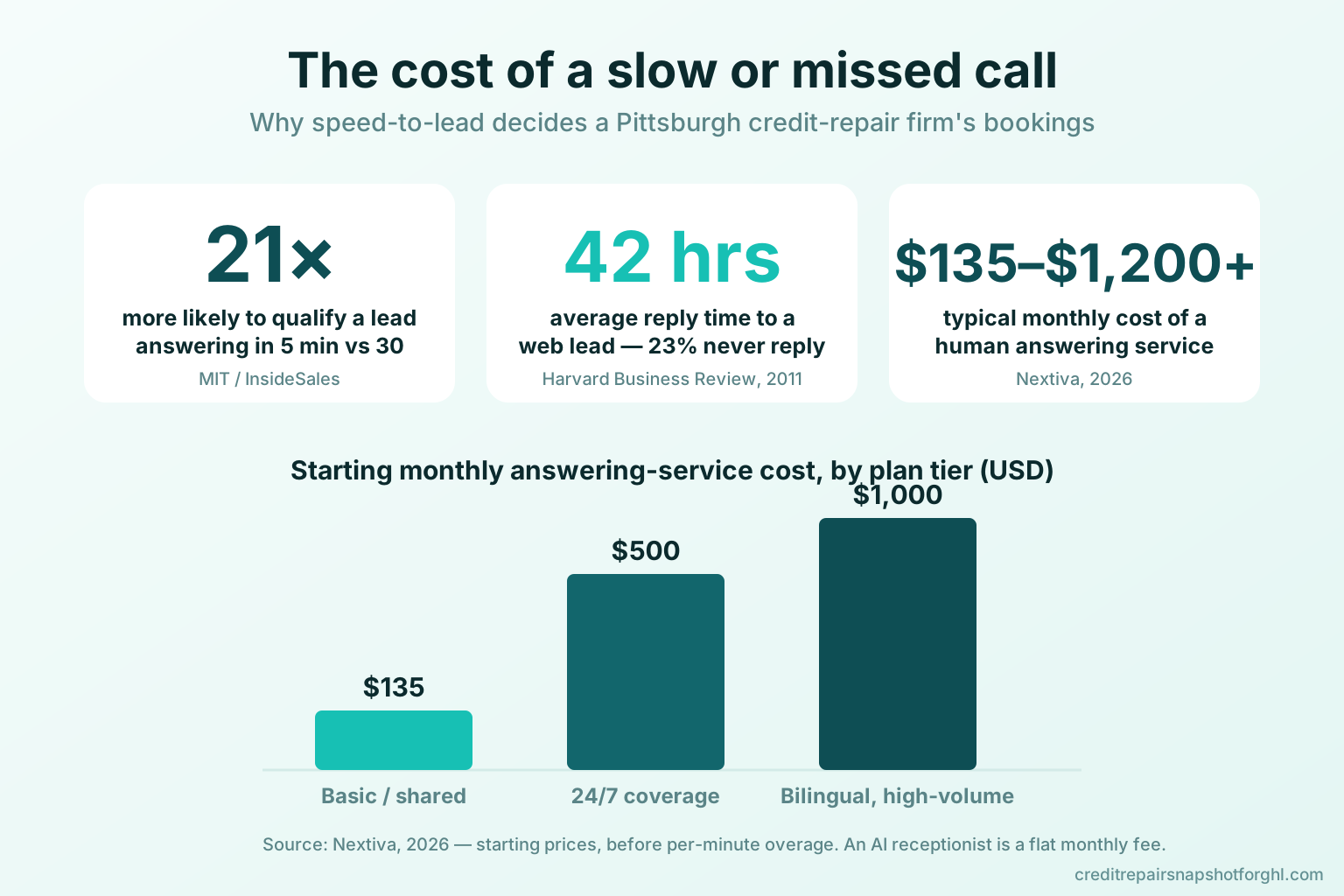
Typical starting monthly cost of a live answering service by plan tier, in USD (before per-minute overage). Source: Nextiva, 2026.
An AI receptionist flips the model. It’s a flat monthly fee for the build and the run, regardless of how many calls come in — so the 40th call of the day costs the same as the first, and a viral referral month doesn’t spike your bill. For a firm that’s actively marketing and expects call volume to rise, that predictability is often the deciding factor, on top of the coverage and booking advantages above. If you’d rather not manage the platform yourself, a done-for-you build folds it into your existing GoHighLevel stack (more on that in our AI lead-generation playbook).
The compliance line neither can cross
This is the part that matters more in credit repair than in almost any other niche, and it applies identically to a human and an AI. Whoever answers your phone is an intake-and-scheduling layer — never a source of advice or a promise.
- No promised outcomes, ever. Neither the AI nor a live agent may say “we’ll delete that” or “your score will jump.” That’s the Credit Repair Organizations Act, and it’s non-negotiable (FTC — CROA).
- Your firm remains the credit-repair organization. You own the written contract, the Consumer Credit File Rights disclosure, the three-day cancellation right, and the ban on charging before services are performed. The receptionist books; it does not advise.
- TCPA consent is captured, not assumed. Any follow-up texting cadence needs proper consent wired into the flow from the start.
So which should a Pittsburgh firm choose?
Use this rule of thumb:
- Choose an AI receptionist if you’re actively marketing, want 24/7 and bilingual coverage, care about booking consults (not collecting messages), want calls logged in GoHighLevel, and want a predictable flat cost as volume grows. That’s most credit-repair firms in a competitive metro like Pittsburgh.
- Choose a human answering service if you have low, steady volume, place a premium on a live person’s touch on every call, and are fine following up on messages yourself.
- Or run both: many firms let the AI receptionist handle the first ring, qualification, and booking 24/7, and route genuinely complex or emotional calls to a human — so nothing is missed and nobody who needs a person is stuck with a bot.
Most “we lost that client” stories in this niche aren’t about price or service quality. They’re about a call that rang out at 8 p.m. The firm that answers first — even with a well-built bot that books the consult — usually wins the client the slower firm never knew it lost.
Whatever you choose, pair it with a booking flow that actually holds the appointment — see cutting no-shows in credit repair — and a website that captures leads after hours, like an AI chat widget for the visitors who’d rather type than call.
How to deploy a CROA-safe AI receptionist
Standing up a voice agent that’s genuinely compliant and wired into GoHighLevel isn’t a weekend DIY project — it’s script design, VAPI/Retell configuration, CRM webhooks, consent capture, and testing. That’s exactly the kind of build we do for credit-repair firms.
Prefer a human to run your whole GoHighLevel operation, receptionist included? A trained, credit-repair-niche GoHighLevel VA can set up and maintain the voice AI, the intake flows, and the follow-up so you never touch the platform. You can also see the AI caller feature in detail.
Frequently asked questions
Is an AI receptionist better than an answering service for a credit-repair firm?
For most credit-repair firms, yes. An AI receptionist answers instantly 24/7, qualifies the caller, and books the consultation directly into your CRM at a flat monthly cost — while a human answering service usually takes a message you then have to chase, which reintroduces the delay that makes you 21× less likely to qualify the lead. A human service wins when you have low, steady volume and specifically want a live person's warmth on every call. Many firms run both: the AI handles the first ring and booking, and complex calls route to a human.
How much does a human answering service cost versus an AI receptionist?
Live answering-service plans typically start around $135–$400 per month, with true 24/7 or bilingual coverage running $500–$1,200 or more before per-minute overage (Nextiva, 2026). Because they bill by interaction, the cost rises as your call volume grows. An AI receptionist is a flat monthly build-and-run fee that doesn't spike when a busy referral month lands — which is why growing firms often prefer it.
Can an AI receptionist stay CROA-compliant?
Yes, when it's scripted correctly. The AI is an intake and scheduling tool — it answers, qualifies, and books, and it never promises an item will be removed or a score will improve. In fact it has a compliance edge: it says exactly what you scripted on every call and logs an auditable transcript. Your firm remains the credit-repair organization responsible for the written contract, the Consumer Credit File Rights disclosure, the three-day cancellation right, and full CROA compliance.
Will callers know they're talking to an AI, and will they hate it?
Modern voice AI (built on VAPI or Retell) is far past the old phone-tree era — it understands natural speech, answers common questions, and books appointments conversationally. Best practice, and often the compliant choice, is to be transparent that it's an automated assistant. Because it answers on the first ring and never puts anyone on hold, most callers prefer it to a voicemail — and genuinely complex or emotional calls can be routed to a human.
Does an AI receptionist work for a Pittsburgh firm with bilingual clients?
Yes. A well-built voice agent detects English or Spanish in the caller's first phrase and runs the matching intake script, logging everything to the same GoHighLevel contact record. Bilingual coverage on a human answering service is usually a higher-tier, agent-dependent add-on, whereas it's built into a custom AI receptionist from day one.
Should I replace my staff with an AI receptionist?
No — it's about coverage, not replacement. The point is that no earned lead rings out at 8 p.m. or during a consult. An AI receptionist takes the after-hours and overflow calls your team can't, books them, and frees your people for the high-value work only a human should do: the consultation, the client relationship, and the dispute strategy. A GoHighLevel VA can manage the whole setup if you'd rather not.
About the author
Simran Kaur designs the client-facing layer of credit-repair firms — the intake conversations, milestone messages, and review pipelines that turn a first call into an enrolled, retained client. She came up through customer success at a fintech startup and now helps firms and their GoHighLevel partners build lifecycle communication that feels personal at scale, from the first ring to the fifth-star review. Her favorite metric is reply rate, and she’s convinced most lost clients are really just unanswered calls. Simran is a fictional editorial persona used for authorship attribution; this article is operational guidance, not legal or financial advice.
Related posts
- Why Credit-Repair Firms Need an AI Receptionist — the business case, in depth.
- How to Set Up an AI Receptionist for a Credit-Repair Business — the step-by-step build.
- AI Chat Widget for Credit-Repair Websites — capture the visitors who’d rather type than call.
- Cut No-Shows in Credit Repair — make sure the booked consult actually shows.
- AI Lead Generation for Credit Repair — the full demand-capture system.
Sources
- MIT / InsideSales — Lead Response Management study (21× / 5-minute rule) — leadresponsemanagement.org
- Harvard Business Review — The Short Life of Online Sales Leads (2011) — hbr.org
- CallRail — 2025 report benchmarking small-business marketing (missed-call rates by industry) — businesswire.com
- Nextiva — How much does an answering service cost? (2026) — nextiva.com
- OnceHub — Answering service cost (2026) — oncehub.com
- Grand View Research — AI Voice Agents Market report — grandviewresearch.com
- Fortune Business Insights — Conversational AI Market — fortunebusinessinsights.com
- Experian — What is the average credit score in the U.S.? (subprime share) — experian.com
- Google Ads policy — prohibited financial products and services (credit repair) — support.google.com
- Meta Transparency Center — Financial Products and Services (Special Ad Category) — transparency.meta.com
- FTC — Credit Repair Organizations Act (CROA) — ftc.gov